Showing posts with label Cy Young What if?. Show all posts

Tuesday, September 3, 2024

REVISITING A TEN-YEAR-OLD POST: 1975 CY YOUNG SUB-SET: 1965 WINNERS

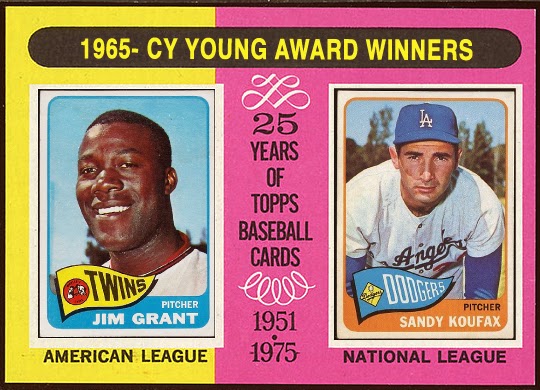
Fun card/post to revisit today: from April of 2014, my 1975 Cy Young winners for 1965 sub-set, imagining if Topps also created a Cy Young set to go along with their wildly popular MVP set in that beautiful, colorful set from just under 50 years ago:


Here's the original write-up for the post from eons ago:
"We're up to 1965 on my Cy Young sub-set for the 1975 set, and once again we are visited by Mr. Sandy Koufax, who would have won his third such award in a row had there been voting for both leagues back then.
Koufax is joined by Minnesota Twins pitcher Jim "Mudcat" Grant, who was selected by the people at SABR as the probable winner in the American League.
For Koufax it was business as usual, as he posted another monster season on the hill, going 26-8 with a 2.04 earned run average and a then Major League record 382 strikeouts.
He also threw eight shutouts among his league-leading 27 complete games, and threw in two saves for good measure.
He also finished second behind Willie Mays for the National League Most Valuable Player award, receiving six first-place votes to Mays' nine.
After 30 some-odd years of looking at his stats I'm still blown away by them! 
What a freaking run of domination.
Over in the American League, Jim Grant came out of nowhere to post what is easily his best year as a Major League pitcher, going 21-7 with a 3.30 E.R.A., a league-leading six shutouts and 142 strikeouts.
Up until the 1965 season, Grant's top win total his previous seven seasons in the bigs was 15 in 1961 for the Cleveland Indians.
For HIS efforts in 1965 he finished sixth in M.V.P. voting, behind teammate Zoilo Versalles in Minnesota's improbable run to the World Series, where they lost to, (who else?), Sandy Koufax and his Los Angeles Dodgers.
Next up, 1966, where the Twins and Dodgers are represented once again, this time with Koufax being joined by Twins' pitcher Jim Kaat."


Wednesday, January 3, 2024

REVISITING A BLOG POST FROM 2014: 1972 CY YOUNG AWARD SPECIAL OF 1975

On the blog today, I wanted to revisit a blog post from almost 10 years ago, part of that year's thread of imagining if Topps also did a Cy Young Award sub-set in their 1975 to accompany the wildly popular MVP set.
What made creating the 1972 award fun was that I had to also recreate cards for both the winners, being that they were shown with their previous teams due to late trades: Gaylord Perry and Steve Carlton:


Really fun "what if?" card to add to the WTHBALLS stable!
Here's the original write-up for that post that was on the blog June 20th of 2014:
"Today's post for my 1975 Cy Young sub-set thread is a fun one since both cards represented for the 1972 award winners have been redesigned.
I already redesigned the 1972 Topps Gaylord Perry card (the American League winner) earlier on the blog, but let me refresh your memory:

For the National League winner, Steve Carlton, I've also gone and redesigned his 1972 Topps card since his regular card in the set still had him as a St. Louis Cardinal.
And I wasn't going to use his "Traded Card" that came out as part of the late-series "traded" sub-set that year.
So before we look at my 1975 "Cy Young 1972 Winners" card, take a look at my redesigned Carlton card:

So with those two new cards designed, here's my 1972 card for the 1975 Cy Young sub-set that I thought would be nice to partner up with Topps' M.V.P. set of the same year:

Both Perry and Carlton were running on all cylinders in 1972, finally putting it all together and posting career years for their new teams.
Perry did everything the Indians were hoping for when they added him to their staff, posting a record of 24-16 (40 DECISIONS!) with a 1.92 earned run average and 234 strikeouts.
He also added 29 complete games, five of which were shutouts, over an incredible 342.2 innings of work.
For Carlton, he dominated, plain and simple, going 27-10 with a 1.97 E.R.A., as well as 310 strikeouts with 30 complete games and eight shutouts.
The man just took over that year on his way to his "Lefty" legend, and both men would find themselves in the Hall of Fame years later, as 3000+ strikeout guys, 300+ win guys, and 20+ year career guys.
Not too shabby…
Next up, 1973 and a return visit from New York Met fireballer Tom Seaver, along with the first appearance from a guy who'd end up a three time Cy Young winner, Jim Palmer.
Stay tuned…"


Tuesday, October 5, 2021

REVISITING AN OLD BLOG POST- DECEMBER 30TH, 2013

Thought it'd be fun to revisit an old post from the blog from about eight years ago, dealing with my imagined 1975 "Cy Young" sub-set mimicking the MVP sub-set, then going one further by citing an old SABR article from a 1993 journal guessing at who would have won the award before it's inception in 1956.

In this case we're looking at 1951, and my card creations for both men since they didn't have cards in the actual 1951 Topps set.
Here's the original write up:

"Back in the early 1990's I picked up the latest SABR Journal and it had a great article that wondered who would have won the Cy Young Award, had there been one, between 1901 and 1955, and who would have also won the award had they given it out in both leagues between 1956 and 1966.
I LOVE stuff like that, as I was also always imagining what the outcome would have been if "this or that" had come to pass.
Well, I recently got the idea to create a "Cy Young Award Winners" series based on the awesome 1975 "Most Valuable Players" sub-set, highlighting who the winners were, or WOULD have been, between 1951 and 1974.
For the "winning" pitchers prior to 1956, as well as the OTHER league winner for those "single-winner" years (56-66), I went with who the SABR people felt would have won as covered in that previously mentioned article.
Heck, if it was good enough for SABR, it's always good enough for me!
Now I'm sure there will be a pick or two that you don't agree with (there were some I wasn't totally convinced of myself). But it IS fun to start the discussion with the SABR picks!
Today we'll start with 1951, as I created a card that showcases who SABR assumed would have won the award: Sal Maglie in the National league and Ed Lopat in the American League.
Take a look at my card design:


Both Maglie and Lopat didn't have a Topps card that year, so I created one for each player (as Topps did for Roy Campanella and Maury Wills for their M.V.P. set). So in essence, I have imagined cards for an imagined card.
Here's a closer look at the "created" cards for this post:


Maglie had a brilliant 1951 campaign, as he lead the Giants in that dramatic pennant winning season with a 23-6 record along with a 2.93 E.R.A.
He pitched in 42 games, of which 37 were starts, and he not only threw three shutouts that year, but threw in four saves as well. Not bad for a guy pitching in only his second full season in the big leagues, at the ripe "old" age of 34!
As it was, Maglie finished fourth in Most Valuable Player voting that year. But it seems he would have been a good pick to win a Cy Young Award in the National league if there was one that year.
For the American league, SABR felt that Ed Lopat of the Yankees would have own the award, based on his 21-9 record and 2.91 E.R.A.
Lopat appeared in 31 games that championship-winning season in the Bronx, and pitched four shutouts with 20 complete games.
There were some other big game winners that year for the A.L. (Bob Feller, Ned Garver, Vic Raschi), but oddly enough they all had high earned run averages that off-set their other accomplishments, and I think that's why SABR went with Lopat.
I think I personally would have gone for Bob Feller instead, or maybe Raschi, but hey, like I said earlier, if SABR makes a pick I can easily go with it too and sleep well at night."

Saturday, July 5, 2014

1975 "CY YOUNG AWARD" SUB-SET: WHAT IF? 1974: THE FINAL CHAPTER

Well, after almost six months of seeing a weekly post regarding my imagined sub-set, "1975 Topps Cy Young Award Winners: 1951-1974", we have finally come to the last post, the 1974 winners: Jim palmer and Mike Marshall.
Take a look at my card design:


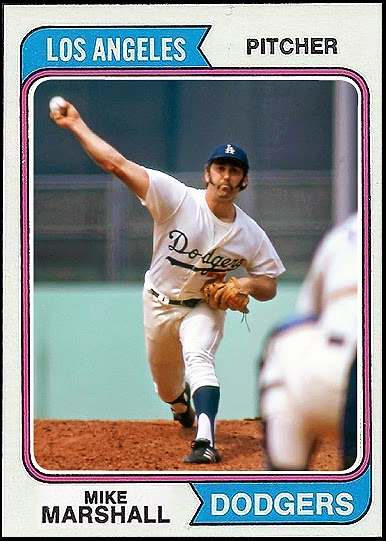
As with my 1972 post, I had to first create a new card for Marshall (Like Steve Carlton in '72), since his regular 1974 card had him as a Montreal Expo.
So I designed a new card showing Marshall as a Dodger, for whom he went on to win the award with in 1974.
Take a close-up look at my redesigned 1974 Mike Marshall card:


And for those who forgot what the original looked like, here you go:


Marshall came to Los Angeles and just put in a season for the ages, as he appeared in a (still) Major League record 106 games, all out of the 'pen, leading the league with 21 saves and 83 games finished.
The man posted 208.1 innings pitched IN RELIEF! Just incredible!
For the season he posted a record of 15-12, with a 2.42 earned run average and 143 strikeouts, not only giving him a Cy Young Award, but a third place finish for Most Valuable Player as well.
Over in the American League, it was a tremendous season for Oakland A's starter Jim "Catfish" Hunter.
After finishing in the top-5 for the award the previous two years, he took it home in 1974 by posting a 25-12 record along with a 2.49 E.R.A.
The wins and earned run average led the Junior Circuit, and he also led the Oakland A's to their third consecutive World Championship, beating the Los Angeles Dodgers and cementing their place as one of the powerful dynasty's in baseball history.
It was the fourth of five consecutive 20-win seasons for "Catfish", his last coming the following year in his first campaign with the New York Yankees.

Well, this was one heck of a thread. Fun to design the cards and write up some of the original information I gathered from the SABR article dating back to 1993 regarding "What if" Cy Young winners between 1951 and 1966.
Since John Hogan and his blog "Cards That Never Were" already did such an amazing job with this same idea put to Rookies of the Year, I'll have to scrap that idea and perhaps apply it to something else.
We shall see what I can come up with…maybe World Champions?
Keep an eye out…

Saturday, June 28, 2014

1975 "CY YOUNG AWARD" SUB-SET: WHAT IF? 1973

Here's a great year for the Cy Young Award: 1973, and the two future Hall of Famers who took it home during the off-season, Jim Palmer and Tom Seaver.
Take a look at my card:


For Palmer, it would be the first of three Cy Young Awards he'd receive in the 1970's, making him one of THE mounds men during his era pitching for the Baltimore Orioles.
Already a three-time 20 game winner before the 1973 season came around, Palmer would go on to post his best Major League season yet, going 22-9 with a league-leading 2.40 earned run average. 
Throw in his six shutouts among 19 complete games, and you also get a second place finish (behind Reggie Jackson) for league Most Valuable Player as well.
Over in the National League we have Tom Seaver, who would win his second such award in 1973 while pitching for the New York Mets.
Although he didn't post 20 or more wins that year, Seaver dominated National League batters, going 19-10 with a league-leading 2.08 earned run average.
He also chipped in 18 complete games, three shutouts and 251 strikeouts, which also paced the Senior Circuit.
Seaver would also go on to win a total of three such awards, and would go on to top 300 wins in 1985 before retiring with 311 total.
Sadly for Palmer, an injury which caused him to miss almost two years in 1967-68, as well as the baseball strike of 1981 would cost him any shot of hitting 300 wins.
But his EIGHT 20 win seasons in the decade were by far the most for any pitcher, and he still managed to finish with 268 wins for his before hanging them up.
This was Seaver and Palmer in the prime of their careers, and each would both have quite a few more stand out campaigns before they were through in the early to mid-1980's.
Next up on this thread is the final post for the "1975 Cy Young Sub-Set", as we take a look at the 1974 winners, thus wrapping up the year-by-year winners up to that awesome 1975 Topps set release.

Friday, June 20, 2014

1975 "CY YOUNG AWARD" SUB-SET: WHAT IF? 1972

Today's post for my 1975 Cy Young sub-set thread is a fun one since both cards represented for the 1972 award winners have been redesigned.
I already redesigned the 1972 Topps Gaylord Perry card (the American League winner) earlier on the blog, but let me refresh your memory:


For the National League winner, Steve Carlton, I've also gone and redesigned his 1972 Topps card since his regular card in the set still had him as a St. Louis Cardinal.
And I wasn't going to use his "Traded Card" that came out as part of the late-series "traded" sub-set that year.
So before we look at my 1975 "Cy Young 1972 Winners" card, take a look at my redesigned Carlton card:


So with those two new cards designed, here's my 1972 card for the 1975 Cy Young sub-set that I thought would be nice to partner up with Topps' M.V.P. set of the same year:


Both Perry and Carlton were running on all cylinders in 1972, finally putting it all together and posting career years for their new teams.
Perry did everything the Indians were hoping when they added him to their staff, posting a record of 24-16 (40 DECISIONS!) with a 1.92 earned run average and 234 strikeouts.
He also added 29 complete games, five of which were shutouts, over an incredible 342.2 innings of work.
For Carlton, he dominated, plain and simple, going 27-10 with a 1.97 E.R.A., as well as 310 strikeouts with 30 complete games and eight shutouts.
The man just took over that year on his way to his "Lefty" legend, and both men would find themselves in the Hall of Fame years later, as 3000+ strikeout guys, 300+ win guys, and 20+ year career guys.
Not too shabby…
Next up, 1973 and a return visit from New York Met fireballer Tom Seaver, along with the first appearance from a guy who'd end up a three time Cy Young winner, Jim Palmer.
Stay tuned…

Wednesday, June 11, 2014

1975 "CY YOUNG AWARD" SUB-SET: WHAT IF? 1971

Up for today on my imagined 1975 Cy Young sub-set is the 1971 season, and the two guys who took home the award: Vida Blue in the American League and Fergie Jenkins in the National League.
Take a look at my design:

 
The Vida Blue card was already on the original M.V.P. card, since he also took home that award as well as the Cy Young in his monster season.
Back on December 24th I focused on the pair of award winning hurlers when I profiled the 1972 "awards" sub-set, where I also redesigned the cards with images of the actual players instead of the awards themselves.
So if you'll allow me some laziness here, I'll "copy and paste" what I wrote then for the two stars here:
 
"Vida Blue burst on to the Major League scene in 1971 with an amazing 24-8 record along with a 1.87 earned run average and 301 strikeouts.
For that he took home both the M.V.P. And Cy Young awards at the ripe old age of 21.
On the National League side, Fergie Jenkins got his award after finishing third the previous year (and would finish third the FOLLOWING year).
To win the award he fashioned a 24-13 record with a 2.77 E.R.A. along with 263 strikeouts. On top of that Jenkins was absolutely in control on the mound, issuing only 37 walks in 325 innings of work!
Easily the most overlooked "big winner" among Hall of Fame pitchers from the era, Jenkins would end up with 284 career wins to go along with 3192 strikeouts and a 3.34 E.R.A.
He would also be the first pitcher to amass over 3000 strikeouts while issuing under 1000 walks, finishing just under the wire with 997 career base on balls. He'd be joined later on by Greg Maddux, Pedro Martinez and Curt Schilling."

Up next is the 1972 season, and with that it leaves us with only four more cards to design and profile before we get to that last year, 1975, when the "M.V.P." sub-set was released in that awesome colorful set.
The 1972 card will be fun, since I first have to design a "regular" card for Steve Carlton as a Philadelphia Phillies player (I'm not using the "traded" card from the '72 set), and I will also be using the redesigned 1972 Gaylord Perry card I designed not too long ago.
It'll make for an even MORE unique card "that never was".
Keep an eye out for it!

Wednesday, June 4, 2014

1975 "CY YOUNG AWARD" SUB-SET: WHAT IF? 1970

Today we move into a new decade as far as the Cy Young Award is concerned, yet we meet up with two players who were pretty well established by then: Jim Perry and Bob Gibson.
Take a look at my 1970 "Cy Young Award Winners" 1975 sub-set design before we delve into the players themselves:


In the American League we have a player who would have won his second such award had they voted for two winners back in 1960.
That year, while pitching for the Cleveland Indians, Perry posted a decent season on an off-year for A.L. Pitchers, and could have walked away with some hardware for his effort (according to the SABR guys).
Ten years later however, he posted an excellent season for the Minnesota Twins, going 24-12 with a 3.04 earned run average, four shutouts and 168 strikeouts, even finishing 9th in M.V.P. voting as well, officially taking home the award for the only time in his career.
As you all know by now, Jim Perry is half of the only brother-duo to both win the Cy Young, as his brother Gaylord took home the award just two years later (and again in 1978).
As a matter of fact, Gaylord ended up in second place for the National League award in 1970, almost giving us an award winning brother duo in the same year!
Gaylord would receive 51 points in 1970, well behind the next guy we're looking at today, Bob Gibson, who received 118 points, and his second Cy Young award.
Smack in the middle of Gibson's dominance over National League batters, he posted awesome numbers in 1970, going 23-7 (the win total marking a career high), with a 3.12 E.R.A., three shutouts and 274 strikeouts.
He'd also take home his sixth Gold Glove Award, as well as get named to his seventh all-star team and finish fourth in the National League M.V.P. Race.
Gibson would eventually become only the second pitcher in Major League history to reach 3000 strikeouts, and find himself elected to the Hall of Fame in 1981, closing out a storied career, all with the St. Louis Cardinals.
Next up on this thread we'll look at the 1971 season, where one league had an established pitcher take home the award, Fergie Jenkins, while another had a super-nova of a bright young star on their hands walk away with it, as well as the Most Valuable Player Award, Vida Blue.

Wednesday, May 28, 2014

1975 "CY YOUNG AWARD" SUB-SET: WHAT IF? 1969

Today we take a look at 1969, the first season after MLB lowered the pitching mound after the "Year of the Pitcher" in 1968 in hopes of stimulating offense, as baseball was losing ground to the N.F.L. in popularity as "America's Game".
Yet while offense did indeed increase a bit over the previous year, there were still some stellar pitching performances to be had.
And the guys that ended up taking home the Cy Young hardware as top pitchers of their respective leagues were Tom Seaver in the N.L. and Denny McLain and Mike Cuellar in the A.L.
As you all know, for the first (and only) time in Cy Young voting, there was a tie, and it has made for somewhat of a unique card in my thread of an imagined "Cy Young" 1975 sub-set.
Take a look at the end result:


I struggled a bit with this one, trying to come up with a nice, clean design that showed all three pitchers, without altering the continuity of my sub-set too much.
And while I wanted to be a bit more "creative" with this card, the best design really was the ho-hum split panel you see here.
Let's start with the National League's top pitcher, Tom Seaver.
While he burst onto the Major League scene as N.L. Rookie of the Year in 1967, and followed up with a solid sophomore season in 1968, this was the year "Tom Terrific" was born, leading the New York Mets to the most improbable World Championship in ages, defeating the heavily favored Baltimore Orioles juggernaut and posting eye-popping numbers that not only would get him the first of THREE Cy Young Awards, but a second place finish in Most Valuable Player voting as well.
Let the numbers speak for themselves: a 25-7 record, 2.21 earned run average and 208 strikeouts, along with five shutouts and a .781 winning percentage.
Fantastic! And only a single vote for Atlanta Braves pitcher Phil Niekro prevented Seaver from unanimously winning the award.
Of course, we all know that Seaver would wind his career with Hall of Fame numbers, totaling 311 wins, a 2.86 E.R.A., 61 shutouts and 3640 strikeouts, easily entering the hallowed halls of Cooperstown in 1992 after seeing his name on 425 of 430 ballots.
I hate to say it since it was at the expense of the Yankees, but I was in attendance the day Seaver logged his 300th win (on Phil Rizzuto day of all days), in 1985 at Yankee Stadium, and man was it a scene! And I have to admit I went home elated at what I just witnessed.
Over in the American League things got a bit more sticky, as voters ended up with a tie, picking the 1968 A.L. Cy Young winner (and Most Valuable Player), Denny McLain of the Detroit Tigers, AND Mike Cuellar, who excelled in his first year as a Baltimore Oriole after some decent years in the National League, mainly as a Houston Astro.
Both pitchers received 10 first place votes, and it's understandable why, with their final numbers being so close.
Denny McLain followed up his 30-win season of '68 with a nice 24-9 record, along with a 2.80 earned run average, nine shutouts and 181 strikeouts over 41 starts, while Mike Cuellar was equally as impressive, posting a 23-11 record with a 2.38 E.R.A., five shutouts and 182 strikeouts over 39 starts for the powerful Baltimore pitching staff that also featured Dave McNally and Jim Palmer.
And while both pitchers didn't end up in the Hall of Fame like their National League counterpart, they did fashion nice Major League careers, Cuellar ending up with a 185-130 record, and McLain with a 131-91 mark.
OK, next up we move into the 1970's, and take a look at the 1970 Cy Young Award winners: Jim Perry of the Minnesota Twins and Bob Gibson of the St. Louis Cardinals.

Wednesday, May 21, 2014

1975 "CY YOUNG AWARD" SUB-SET: WHAT IF? 1968

Well, here's a card that didn't need much work since both M.V.P. Winners in 1968 were pitchers, so the card images remain the same with only the banner text needed a change.
1968, the "Year of the Pitcher".
And what more evidence does anyone need than the fact that both Most Valuable Players that year were indeed moundsmen: Bob Gibson of the St. Louis Cardinals and Denny McLain of the Detroit Tigers.
First, let's refresh our memories and look at the 1975 sub-set design for the Cy Young winners:


As I stated, all that was changed here was the banner title.
The two pitchers collected some serious hardware that year, as they posted memorable pitching performances that still resonate to this day!
In the American League, Denny McLain was already a solid starter for the Tigers as the 1968 season opened, but MAN did he explode that year, posting sick numbers like a 31-6 record with a 1.96 E.R.A. and 280 strikeouts!
He also threw 28 complete games with six shutouts in 41 starts, good for 336 innings pitched.
Staggering by today's standards.
Yes, he's the last Major League pitcher to post 30+ wins, but he's actually also the ONLY pitcher in the past 79 years to reach that number! 
You have to go all the way back to 1930 and Cardinals pitcher Dizzy Dean before you find another 30 game winner.
McLain would also win another Cy Young the following year (shared with Orioles pitcher Mike Cuellar), but would quickly deteriorate, having his career come to an end just four years after his monumental 1968 display.
It's hard to imagine because they guy always looked so much older than he really was on his cards, but McLain was only 24 years old in 1968! Look at him, he looks ten years older at least!
He never even made it to 30 years of age during his playing days, as he left the game after the 1972 season when he split time with the Atlanta Braves and Oakland A's.
In the National League, we all know the story there as well: Bob Gibson was absolutely LIGHTS OUT, rolling to a 22-9 record with a microscopic 1.12 earned run average and 268 strikeouts to go along with his 28 complete games and THIRTEEN shutouts!
You know, even though I have gone over every single box score from his '68 season, I STILL can't believe how this guy lost nine games that year! It's baffling to me even today.
Gibson was smack in the middle of his pitching hey-day, posting the third of his five 20+ win seasons, winning the first of his two Cy Young Awards, and leading the Cardinals to the World Series for the third time, though losing to the Tigers in the Fall Classic.
Let's also not forget that Gibson also took home the fourth of his nine Gold Glove Awards that season as well.
About as fierce a competitor the game has ever seen! 
On a side note-that 1968 season was so ridiculous as far as pitching went, it's the equivalent to what the 1930 National League season was to batting.
Check out these facts from that season:
No less than seven pitchers posted sub-2.00 earned run averages; the American League leader in batting was Carl Yastrzemski with a crisp .301 average, McLain's 1.96 E.R.A was only good for fourth place in his league, with Luis Tiant, Sam McDowell and Dave McNally all posted lower numbers, and my favorite number of all: there were 49 Major League pitchers that season who posted an E.R.A. under 3.00! Forty-Nine!
There were only 20 teams in the Majors then, so we're talking 2.5 pitchers a team had an E.R.A. under 3.00.
There were also nine guys who posted a WHIP under 1.00!
Just amazing.
It's no surprise Major League Baseball swung the pendulum the other way right quick, trying to boost offense as they were losing ground to American audiences to the N.F.L., lowering the pitching mound and eventually creating the much disputed Designated Hitter in the American League five years later.
Anyway, next up on this thread is the 1969 season, and it'll be a bit of a change, showing three pitchers instead of two, as I stated earlier Denny McLain would share the Cy Young with Mike Cuellar for the American League honors, while Tom Seaver would win the National League award as he led the "Miracle Mets" to an unlikely World Championship.

Wednesday, May 14, 2014

1975 "CY YOUNG AWARD" SUB-SET: WHAT IF? 1967

OK.
Today we move past the "Koufax-Era" and spotlight the 1967 Cy Young Award winners in my imagined 1975 sub-set based on the awesome M.V.P. version Topps had in their set that year.
Turns out the card I needed to design took a little more work than expected since the National league's winner that year, San Francisco Giant Mike McCormick, was actually pictured as a Washington Senator in the 1967 set.
So, along with the as-issued card of American league winner Jim Lonborg of the Boston red Sox, I had to create a Giants card for McCormick before I dropped them onto the 1975 sub-set card.
Here's what McCormick's card looked like in the 1967 set:


And here's my creation, showing him as a Giant pitcher:


Now let's move onto my design for the sub-set showing the Cy Young Award winners for the 1967 season:


This was the first year that there was a Cy Young winner picked for BOTH leagues, so we are now past the SABR selections of presumed winners in whichever league wasn't represented between 1956-1966.
Both pitchers really came out of nowhere to post career years that season.
Jim Lonborg helped lead the Boston Red Sox to their first World Series appearance since 1946, mainly on the shoulders of Triple Crown winner and Most Valuable Player Carl Yastrzemski.
By the time the season ended Lonborg's numbers were outstanding, finishing with a league-leading 22 wins against nine losses, along with a league-leading 246 strikeouts and a 3.16 earned run average.
He also started a league-high 39 games and completed 15 of them, good for 273.1 innings pitched and two shutouts.
It was only his third full season in the Majors, and sadly for Lonborg easily the high point of his career, though he did win 18 games for the Phillies in 1976 with an even better E.R.A. than 1967 at 3.08.
However immediately after his great '67 season, he faltered in 1968 to a 6-10 record with a 4.29 E.R.A., never really coming close to all-star numbers again in his 15 year career.
In the National league, McCormick was a well worn veteran by the time he rejoined the Giants after four seasons of toiling in the American League for the Baltimore Orioles and Senators between 1963-1966.
Originally up in the big leagues as a seventeen year old for the New York Giants in 1956, he actually won the National League E.R.A. crown back in 1960 at the ripe-young-age of 21 when he posted 2.70.
That season also saw him go 15-12 with four shutouts and three saves, but would be his best season in the Majors until 1967 rolled around.
Finding himself in the N.L. again seemed to revitalize his career, as he cruised to a 22-10 record with a nice 2.85 earned run average and five shutouts to go along with 150 strikeouts.
To be honest, I personally wonder why the award didn't go to either Jim Bunning or Fergie Jenkins, both future Hall of Famers, as their numbers seem to be better overall.
But McCormick left them in the dust when voting was announced, 18 votes to one each for Bunning and Jenkins.
Like Lonborg, sadly McCormick's career would quickly fall apart, as he was only able to win 12 games the following year, and 11 the next before playing out the last two years of his career with the Giants, Yankees and Royals to the tune of a 7-4 record with an above-6.00 E.R.A. before calling it a career after 16 seasons.
It really was a curious oddity that these two guys would pop out of obscurity and claim the top pitching prize in the same season, leading their team to excellent seasons before falling out of sight somewhat by the time the decade came to a close.
Definitely one of the more interesting Cy Young Award years of the era.
Next up on this thread, the "Year of the Pitcher"!
1968 and the absolute domination of Denny McClain and Bob Gibson, not only Cy Young Award winners for the respective leagues, but Most Valuable Players as well!
Stay tuned…

Tuesday, May 6, 2014

1975 "CY YOUNG AWARD" SUB-SET: WHAT IF? 1966

Today we'll look at the final year of the "Koufax-era" in my imagined 1975 Cy Young Award sub-set, 1966.
After a run of domination hardly seen in Major League baseball before or since, Koufax would retire from the game at season's end and shock many fans because of serious arm-trouble.
Along with Koufax and his third Cy Young in four years, the fine folks at SABR picked Jim Kaat of the Minnesota Twins as the American League Cy Young winner had they chosen one in each league at that time.
First up, my card design:


This would be the final year of voting on one winner for the award before they began voting on winners for both leagues beginning in 1967.
Koufax was once again out of this world spectacular, posting a record of 27-9 with a 1.73 earned run average and 317 strikeouts, all league leading figures.
He also lead the league in games started (41), complete games (27), innings pitched (323) and shutouts (5), easily taking home the award and unexpectedly capping a Hall of Fame career before injuries halted his career at age 30.
Sadly the season was also marred by the Dodgers' surprising loss to the Baltimore Orioles in the World Series, getting swept mainly because of the "Birds" up-and-coming young pitching studs Jim Palmer, Wally Bunker and Dave McNally, along with a surprise performance by reliever Moe Drabowsky in the first game.
Six years later Koufax was inducted into the Hall of Fame, getting named to 344 of 396 ballots when voting was announced.
Perhaps only Pedro Martinez' run in the late 90's/early 00's was there be another pitcher who had a run that far out-shined the rest of his league for a few years like Koufax's run between 1963-1966.
Over in the American League, the Twins were once again the beneficiaries of a fine performance by one of their young pitchers, this time Jim Kaat.
After a nice five year run between 1962-1965, Kaat came into his own in '66, finishing the season with a league-leading 25 wins (against 13 losses), a 2.75 E.R.A., and 205 strikeouts, while also leading the league in starts (41), innings pitched (304.2) and complete games (19).
He also picked up his fifth of what was to become 16 Gold Gloves in his 25 year career while finishing in fifth place in M.V.P. Voting.
Kaat would have two more 20-win seasons, in the 1970's while pitching for the Chicago White Sox, before switching over to relieving the final few years of his lengthy career in the early-80's with the St. Louis Cardinals.
Next we take a look at the first season where TWO Cy Young winners were selected, one for each league, 1967.
For the National League we have Giants pitcher Mike McCormick, while in the American League we have Red Sox hurler Jim Lonborg.
Two guys who easily had career years that season.

Monday, April 28, 2014

1975 "CY YOUNG AWARD" SUB-SET: WHAT IF? 1965

We're up to 1965 on my Cy Young sub-set for the 1975 set, and once again we are visited by Mr. Sandy Koufax, who would have won his third such award in a row had there been voting for both leagues back then.
Koufax is joined by Minnesota Twins pitcher Jim "Mudcat" Grant, who was selected by the people at SABR as the probable winner in the American League.
Take a look at my card design first:


For Koufax it was business as usual, as he posted another monster season on the hill, going 26-8 with a 2.04 earned run average and a then Major League record 382 strikeouts.
He also threw eight shutouts among his league-leading 27 complete games, and threw in two saves for good measure.
He also finished second behind Willie Mays for the National league Most Valuable Player award, receiving six first-place votes to Mays' nine.
After 30 some-odd years of looking at his stats I'm still blown away by them! 
What a freaking run of domination.
Over in the American League, Jim Grant came out of nowhere to post what is easily his best year as a Major League pitcher, going 21-7 with a 3.30 E.R.A., a league-leading six shutouts and 142 strikeouts.
Up until the 1965 season, Grant's top win total his previous seven seasons in the bigs was 15 in 1961 for the Cleveland Indians.
For HIS efforts in 1965 he finished sixth in M.V.P. voting, behind teammate Zoilo Versalles in Minnesota's improbable run to the World Series, where they lost to, (who else?), Sandy Koufax and his Los Angeles Dodgers.
Next up, 1966, where the Twins and Dodgers are represented once again, this time with Koufax being joined by Twins' pitcher Jim Kaat.

Wednesday, April 16, 2014

1975 "CY YOUNG AWARD" SUB-SET: WHAT IF? 1964

Next up on my imagined 1975 Cy Young sub-set s the 1964 season and we are now fully entrenched in the Koufax-era, even though he didn't take home the award that season because of limited playing time.
The actual winner of the award was Angels pitcher Dean Chance, who had his peak season that year, while Koufax would have won the award had there been a selection for both leagues at the time.
First up, my card design:


As I mentioned yesterday for my "all-decade" card featuring Chance, 1964 was the culmination of his relatively short 11-year career, going 20-9 with a fantastic 1.65 earned run average largely based on his 11 shutouts in 35 starts. He even appeared in another 11 games, earning four saves in the process.
The rest of his numbers were good ones: a league-leading 15 complete games and 278.1 innings pitched, 207 strikeouts, a .690 winning percentage, and he only gave up 7 homers and 51 earned runs all season long.
So when Cy Young voting came around, writers easily picked him over Chicago Cub hurler Larry Jackson and Koufax, garnering 17 of 20 first place votes.
He'd go on to have a few more good seasons with the Angels and Twins, but would be out of the game by 1971 at the young age of 30.
Ironically, the player the folks at SABR picked to be the "assumed" winner of the National League Cy Young Award was another guy who was out of the Majors by the age of 30, Koufax.
It's incredible to think that during his run of dominance in the game from 1963 to 1966, this season would be his "down" year.
Ha! A year that saw him go 19-5 with a 1.74 E.R.A., a .792 winning percentage, seven shutouts and 223 strikeouts, all but the K's being league-leading numbers.
Problem was that Koufax's season was cut short after a start in August because of what was diagnosed as "traumatic arthritis", so missing out on the last month and a half of the season EASILY cost him a Cy Young, which would have made four in a row to close out his career, and adding to the legend of one of the most fantastic runs of success on the mound the game has ever seen before or since.
It IS amazing to realize that of the three pitching "Triple Crown" categories: wins, E.R.A., and strikeouts, between 1963-1966, Koufax lead the league 10 of twelve times!
Only his wins and strikeouts from 1964 would prevent a clean sweep.
The man was almost unstoppable.
Next up on this thread: 1965, and low-and-behold, another Sandy Koufax appearance, taking the award home for the second time, with the American League's Jim Grant getting picked by SABR as the pitcher most likely to have won if today's voting process was in place then.
Stay tuned…

Friday, April 11, 2014

1975 "CY YOUNG AWARD" SUB-SET: WHAT IF? 1963

Today's post regarding my imagines 1975 Cy Young Award sub-set brings us to the 1963 season, and the beginning of the Sandy Koufax era.
Let's take a look at my card design first:


Before we praise the "Left Arm of God", let's take a look at whom the people at SABR figured would win the American League Cy Young Award had there been such a vote in place at the time, Yankees great Whitey Ford.
Having won the award himself just a couple of years earlier in 1961, Ford posted another awesome season in 1963, ending up with a 24-7 record to go along with a 2.74 earned run average and 189 strikeouts.
The effort got him a third place finish in M.V.P. voting, and easily would have gotten him another Cy Young to go with it.
Besides the league-leading win total, Ford also led in starts with 37 and innings pitched with 269.1, with 13 complete games and three shutouts. He also had a save in there as well.
Ironically enough his 1964 season would actually be better even though his won-loss record was 17-6, as he posted a career high eight shutouts with a sparkling 2.13 earned run average with 172 K's. 
It was to be his last great season of his career, as Ford tailed off between 1965 and 1967, hanging them up after that year.
In the National League, we take a look at who did win the award, and would win the award three of the next four years, and easily four of four had there been an award for both leagues in place then: Dodger great Sandy Koufax.
1963 would be the first year in a dominating run that I can honestly say wasn't matched until a guy named Pedro Martinez came along in the late-90's.
Let's look at the numbers shall we: 25-5 record, 1.88 E.R.A., 11 shutouts and 306 strikeouts. Incredible!
Throw in a league-leading 0.875 WHIP, 6.2 hits-per-nine-innings and an amazing 5.28 K's to walks ratio (which is incredible considering how wild Koufax was the first half of his career), and you have not just a Cy Young Award season, but a Most Valuable Player season, which is what he also took home that year.
What a run Koufax had between 1963 and 1966. He led the league in wins three times, E.R.A. four times, winning percentage twice, shutouts three times, strikeouts three times, and took home three Cy Young Awards, and an M.V.P. Award, while finishing in second place in both 1965 & 1966.
Man if only we could have seen where his career totals would have been had he been able to pitch an extra four or five years before retiring.
Sadly at the ripe old age of 30, Koufax was forced to retire because of arm trouble, leaving us with those "what-if's" that will never go away, along the lines of the Ted Williams, Bob Feller and Stan Musial military years.
Next up, the 1964 season with Dean Chance, the actual award winner, and of course, Mr. Koufax…

Friday, April 4, 2014

1975 "CY YOUNG AWARD" SUB-SET: WHAT IF? 1962

The Dodgers and Yankees had the Most Valuable Players in their respective leagues in 1962, and if the people at SABR have anything to do with it, the two teams would also have the Cy Young winners as well.
As we all know, Dodger great Don Drysdale went on to win the award that season, when it was only given to one pitcher instead of one in each league.
But according to a great article from 1993 in a SABR journal, the consensus winner in the American League would have been Yankee pitcher Ralph Terry.
First take a look at my card design for the 1962 entry in my imagined 1975 sub-set:


For Terry, he finally seemed to put it all together in 1962 after six seasons in the big leagues, going 23-12 with a 3.19 earned run average in a league-leading 39 starts.
The previous year he had his first truly successful year in the big leagues, going 16-3 for the Yanks. But it was 1962 that would be the pinnacle of his 12 year career.
In addition to the stats mentioned, he also led the American League in innings pitched with 298.2, getting him selected for his only All-Star game and a 14th-place finish in M.V.P. voting at the end of the year.
He would also end up being voted most valuable player of the World Series, as he won two games against the San Francisco Giants, most importantly, a 1-0 shutout win in Game 7 with Willie McCovey famously lining out to second baseman Bobby Richardson with the winning runs on base.
This would atone for his "other" well known World Series moment: giving up Bill Mazeroski's 7th-game/ninth-inning home run to win the series for the Pittsburgh Pirates in 1960.
Terry would wind up his career after the 1967 season with the New York Mets, posting a 107-99 record with a 3.62 E.R.A in 257 starts and 338 games.
As for the actual winner of the Cy Young in 1962, Don Drysdale, he was already a feared star on the mound for the Dodgers by the time he really got it all together in '62.
But that year he was simply awesome, posting a leading 25-9 record with a 2.83 E.R.A. and a league-leading 232 strikeouts over 41 starts (also tops in the N.L.).
Though the Dodgers fell just short of the World Series that year, they'd be vindicated the following year with the arrival of one of the all-time best one-two punches on a Major League mound: Drysdale and the emergence of a guy named Sandy Koufax (you'll be seeing a lot of his on this thread over the next few weeks!).
The Dodgers would go on to sweep the Yankees in the World Series in 1963, but Drysdale would be taking a back-seat to Koufax as the ace of the Dodger staff.
But 1962 would be Drysdale's year, easily distancing from the rest of the pack in Cy Young voting, getting 14 of 20 votes to beat out Giants pitcher Jack Sanford.
By the time "Big D" was done, he'd retire at the young age of 32 with a 209 and 166 record, 49 shutouts, a 2.95 E.R.A.,  and 2486 strikeouts.
It took him a while, but he finally got voted into the Hall of Fame in 1984, though many consider him a borderline Hall of Fame member at best (like Catfish Hunter among others).
Next up, 1963 and the beginning of the "Sandy Koufax Era". The man was simply unstoppable from 1963 through 1966.
If only we could have seen him pitch into the 1970's. Boy oh boy…
In the A.L., it was pretty clear that the winner would have been Whitey Ford had they given the award for both leagues at the time.
See you then…

Wednesday, March 26, 2014

1975 "CY YOUNG AWARD" SUB-SET: WHAT IF? 1961

Next up on my 1975 Cy Young Award sub-set thread is 1961, and the year Whitey Ford finally took home the award.
Seems everything went right for the Yankees that year, and Ford was either the beneficiary of all that stuff going right, or a heavy reason WHY it all went that way.
For the National League, the fine folks over at SABR felt that none other than Warren Spahn would have won what would have been his third award had there been a winner for each league back then.
Take a look at my card design for 1961 first:


Even though Ford had many fine seasons leading up to 1961, it really did all come together that year, as he posted a 25-4 record with a 3.21 earned run average and three shutouts over 39 starts and 283 innings.
It would also be the only year he'd top 200+ strikeouts in a season, with 209, and oddly enough, the only year in his career where he'd give up 100+ runs and earned runs in 16 years in the big leagues.
With his 25-4 record in 1961, Ford's career winning percentage at the time stood at an incredible .714, with 150 wins against 63 losses.
As a matter of fact, if it wasn't for his final two years in the Majors, 1966 and 1967, Ford would have been only the second pitcher in Major League history with more than 200 wins and less than 100 losses (Bob Caruthers STILL being the only one with a record of 218-99), as well as finishing with a career winning percentage over .700 (at .705), something no one with over 200 career wins has ever done before or since.
Over in the National League, Braves pitcher Warren Spahn once again takes center stage, this time at the ripe old age of 40, as he finished the aseason with a record of 21 and 13, with league leading numbers of: 3.02 earned run average, 21 complete games and four shutouts.
Like I've stated earlier, the man was a machine.
You think he was done yet? How about a record of 23-7 two years later at the age of 42?!
Just incredible to think he also missed three years in his early 20's to military service, and he still ended up 363 career wins.
1961 was the sixth year in a row that Spahn posted 20+ wins, as well as the twelfth time he topped that number.
Awesome couple of future Hall of Famers here.
Next up, 1962 and the winner, Dodger great Don Drysdale, and who the SABR guys thought would win, Yankee pitcher Ralph Terry.
Stay tuned…

Tuesday, March 18, 2014

1975 "CY YOUNG AWARD" SUB-SET: WHAT IF? 1960

Today we move into a new decade regarding my 1975 Topps "Cy Young Award" sub-set based on the popular M.V.P. Sub-set of the same year.
1960 was not only the dawn of a new decade, but the dawn of a new era in baseball, with new stars popping up and staking their claim to fame in the sport.
The outright Cy Young winner that year ended up being a "new" name of sorts, Pittsburgh Pirates pitcher Vern Law, who guided the Bucs to the World Series and an eventual shocking win against the heavily favored New York Yankees on the now legendary Bill Mazeroski home run in the seventh and final game.
Over in the American League, the people at SABR felt that relative newcomer Jim Perry (brother of future Hall of Famer Gaylord Perry, and eventual Cy Young winner himself in 1970) would have taken home the award had there been winners in EAXCH league at the time.
First up, my card design for the card as part of my imagined 1975 sub-set:


Although Vern Law was already beginning his ninth season as a big-league pitcher when 1960 broke, it was only in the past two seasons that he established himself as a solid starter, winning 14 and 18 games respectively in 1958 & 1959.
He'd carry that success right into the 1960 season, ending up as the anchor of the Pirate staff, going 20-9 with a 3.08 E.R.A., along with a league-leading 18 complete games and 120 strikeouts with three shutouts in 35 starts.
Personally, I think St. Louis Cardinal pitcher Ernie Broglio had a better season on the mound, but it wouldn't be the first time that an award was influenced by a team reaching the post-season (something they say doesn't factor in awards voting).
Regardless, Law would end up a solid starter for the rest of his 16-year career, retiring after the 1967 season, all for Pittsburgh.
In the American League, it's fun to see a "rookie" card in this card design, as Jim Perry finished second in 1959 for A.L. Rookie of the Year, going 12-10 with a nifty 2.65 E.R.A. pitching for the Cleveland Indians.
1960 would also be somewhat successful for him, ending the year with an 18-10 record, the win total pacing the Junior Circuit, with a high 3.62 earned run average and league-leading four shutouts and 120 strikeouts.
While those numbers don't seem to jump off the page, 1960 didn't have a pitcher in the American League who posted stellar stats.
Nowadays you could make an argument for Jim Bunning winning the award, even with a losing record of 11-14.
Besides that record, he had better numbers than other hurlers in the A.L., based on his 2.79 E.R.A., 201 strikeouts and three shutouts.
But alas, we'll never know who would have won the American League Cy Young, as the voting wasn't yet set up that way until 1967, where there'd be a winner for each league.
Next up, 1961, which saw Whitey Ford win his only Cy Young Award, while in the National League, Warren Spahn would have almost assuredly taken home the award at the ripe old age of 40!
Keep an eye out for it…

Friday, March 7, 2014

1975 "CY YOUNG AWARD" SUB-SET: WHAT IF? 1959

Next up on my 1975 "Cy Young Award" thread is the 1959 season, with Early Wynn of the Chicago White Sox as the actual winner when the award was only given to one player, and Sam Jones of the St. Louis Cardinals as the supposed National League winner according to the folks at SABR.
Take a look at my card design first:


Early Wynn was already a long time veteran by the time the 1959 season came along, and even at the age of 39 he still had a lot left in the tank.
Pitching in his second season for the White Sox, Wynn lead them to the World Series against the Los Angeles Dodgers, going 22-10 with a 3.17 E.R.A with five shutouts over a league-leading 255.2 innings.
Not bad for a guy who first appeared on a Major League mound 20 years earlier as a 19-year old for the Washington Senators.
Wynn would eventually reach that magical 300th win in 1963, retiring soon after, ending his career with a 300-244 record and a Hall of Fame induction in 1972.
At the height of his career he was a member of perhaps one of the best pitching staffs in baseball history with the Cleveland Indians of the 1950's. This was a staff that featured two other future Hall of Famers: Bob Lemon and Bob Feller, as well as star Mike Garcia, along with other productive arms like Herb Score, Art Houtteman, and in a part time role as he was closing out his career, Hal Newhouser.
Sadly for the Indians, they would constantly have to take a back seat to the Yankee dynasty of the decade, only managing to end up at the top in 1954 when they set the then American League record of 111 wins on their way to a World Series loss to the New York Giants.
Over in the National League, in a year where no one pitcher took the lead and dominated, we have Sam Jones posting up solid numbers in his first year pitching for the San Francisco Giants after being traded from the Cardinals (hence the fact that he's shown as a Cardinal on the 1959 Topps card), leading to a probable Cy Young win for him in the N.L. had they selected a winner for each league back then.
For the year, Jones posted a record of 21-15, leading the league in wins, along with a league-leading 2.83 earned run average and four shutouts to go along with 209 strikeouts.
He even managed to tack on four saves during the year as he appeared in 50 games, with 35 of them being starts.
1959 was easily the best season of Jones' career, but he did have one more good year in 1960 as he posted an 18-14 record with a 3.19 earned run average, three shutouts and 190 strikeouts.
After that he patched together four more years with the Giants, Tigers, Cardinals and Orioles before retiring after the 1964 season.
During his career Jones lead the National League in strikeouts three times, with a high of 225 in 1958 with the Cardinals, but also lead the league in walks four times, with a whopping high of 185 in 1955 while hurling for the Chicago Cubs.
By the time he retired he had a final record of 102-101 with a 3.59 E.R.A and 1376 K's in only 1643.1 inning s pitched.
Next on this thread we move into the 1960's, and have the actual Cy Young winner that year, Vern Law of the Pittsburgh Pirates, and the proposed American League winner, Jim Perry, brother of future Hall of Famer Gaylord Perry.
Keep an eye out for it.

Wednesday, February 26, 2014

1975 "CY YOUNG AWARD" SUB-SET: WHAT IF? 1958

We're up to 1958 on my thread imagining a 1975 Topps sub-set featuring all Cy Young Award winners since the company's inception in 1951, just like their sub-set during the same year of Most Valuable Players.
Two of the fun aspects of doing this thread are: designing cards for players that originally were not issued by Topps that year, and "awarding" the Cy to pitchers from the league that didn't have a winner between 1956 and 1966 based on a old SABR article in 1993.
So with that, take a look at my 1975 "1958 Cy Young Award" card design:


For the American League we have the "gimmie", as New York Yankee hurler Bob Turley actually did win the award in 1958.
That season it all came together for Turley, who was in his seventh season in the big leagues.
In his fourth season pitching for the Yanks after three with St. Louis/Baltimore, Turley handed in his finest performance in the Majors, going 21-7 with a 2.97 earned run average and 168 strikeouts, leading the Yankees to the World Series and avenging a loss the previous year to the Milwaukee Braves.
For good measure Turley would also end up second in Most Valuable Player voting behind Jackie Jensen, leading the league in wins, winning percentage, complete games and hits-per-nine-innings.
Sadly for Turley he'd never come close to that performance again, as he'd never again reach double-digits in wins through the next five years of his career before hanging them up after the 1963 season split between the Angels and Red Sox.
Over in the National League, we could have had the first pitcher to win three Cy Young Awards had today's selection practice been in place back then, as the guys at SABR selected Warren Spahn, the previous year's winner of the award, as their N.L. recipient.
Spahn was actually just edged out by Turley in the 1958 voting, losing the award by one vote, 5-4.
So needless to say he easily would have won his third Cy Young Award (1953 and 1957 being the others) beating out Sandy Koufax by about ten years as the first to rake in three such trophies.
The 1958 season for Spahn was more of the same for the lefty, as he posted a 22-11 record with a 3.07 earned run average and 150 strikeouts. 
He'd lead the N.L. in wins, winning percentage, complete games, innings pitched, and WHIP, getting named to his 10th All-Star game.
The guy was 37 years old this year, and he STILL had another four 20-win seasons left in that amazing arm of his.
Next up, 1959, with the actual winner Early Wynn for the "Go-Go" Chicago White Sox, and SABR's pick in the National League: Sam Jones of the San Francisco Giants.

FOLLOW ME ON TWITTER...

@wthballs
Everything baseball: cards, events, history and more.