Showing posts with label Missing All Stars. Show all posts

Sunday, June 14, 2015

MISSING 1970 ALL-STAR: MEL STOTTLEMYRE- RHP

Today I post the final player that really should have had an all-star card in the 1970, since he was a starter for the American League, the A.L. starting pitcher for the 1969 game, Yankee Mel Stottlemyre:


While two-time Cy Young winner Denny McLain got the nod by the Sporting News as their right-handed all-star, Stottlemyre in fact started the game, and it's somewhat a perfect example of how this guy is always overlooked and under-appreciated in my eyes considering all he did in basically ten years of Major League ball.
With a half-season in 1964 (his first year), and 1974 (his last), he put up nine full seasons in between, and all but one (1966) rock solid for some poor Yankee teams.
In nine full years on the mound, he posted three 20-win seasons (all while pitching during the Bronx "lean years"), five sub-3.00 ERA years, seven 15+ win seasons, nine 250+ innings seasons,  and six years of four or more shutouts, topping out with seven in both 1971 and 1972.
How solid is THAT!?
A five-time all-star, I can't even imagine what his win totals could have been had he stayed healthy and pitched into the late-1970's/early-80's, or even if he wasn't starring for those bad Yankee teams post-dynasty between 1965-on.
Consider his numbers in the small amount of time he was a Major League pitcher: a 164-139 record, with a nice 2.97 ERA, 40 shutouts and 1257 K's in only 356 starts!
Those are really some seriously great numbers.
Sadly because of a rotator-cuff injury in 1974, he had to retire at the young age of only 32, leaving us to wonder "what could have been".
Of course we know that he later went on to become one of the most respected pitching coaches in the Majors from the 1980-s with the Mets on through to the "new" Yankee dynasty in the late-90's/early-00's, before retiring for good after the 2008 season.
A great, solid career that get's overlooked for a few different reasons. I have to figure out some sort of "tribute" card for the guy, one way or another…

Friday, May 29, 2015

MISSING 1970 ALL-STAR: SAL BANDO- 3B

Here's the next "missing" all-star card from the 1970 Topps set: Sal Bando, the starting American League third baseman.


Now, I don't know why Brooks Robinson wasn't the starter, as it seems he wasn't injured or anything, but Sal Bando joined fellow teammate Reggie Jackson in the starting line-up, and were giving everyone a look at the budding dynasty the Oakland A's were about to become.
Bando put together a very solid 16-year career that saw him take home three championships, participate in four all-star games, and finish in the top-10 in MVP voting three times.
His five 20-homer and two 100+ RBI seasons were a nice compliment to Reggie's offensive exploits, and with Joe Rudi, Gene Tenace and Bert Campaneris thrown in you can see why those A's teams were so strong.
Then again, with starting pitching like Vida Blue, Catfish Hunter, Ken Holtzman, Rollie Fingers et al, yeah, they were going to kick-ass no matter what…

Wednesday, May 20, 2015

MISSING 1970 ALL-STAR: CLEON JONES- OF

The next "missing all-star" from the 1970 Topps set (as explained earlier on this blog), is former New York Mets star outfielder Cleon Jones.
Check out my card first:


Jones started the all-star game and was having his best Major League season in 1969, on his way to a .340 batting average with 92 runs scored and 75 runs batted in, paired up with twelve homers and 16 stolen bases.
Those numbers got him a seventh-place finish in MVP voting, and a lot of love in NYC among Mets fans.
Jones would play twelve of his 13-years in the Major Leagues with the Mets, finishing up in 1976 with a scant twelve games playing for the Chicago White Sox.
He'd finish with a .281 career average, with 1196 hits in 4263 at-bats over 1213 games, and of course a World Championship with the 1969 "Miracle Mets".

Friday, May 15, 2015

MISSING 1970 ALL-STAR: FRANK HOWARD- OF

Here's the second "missing" all-star card from the 1970 Topps set: outfielder Frank Howard of the Washington Senators:


As I stated in the first post for this thread with Steve Carlton, though Topps had the Sporting News all-star selections for their all-star sub-set, I think it wasn't fair to leave out the players who actually started the game.
"Hondo" was one of the starting outfielders for the American League, and he was crushing the ball during this era.
He unleashed three straight years of 40+ home runs, topped 100 runs batted in each year and topped the American League in total bases in 1968 and 1969.
As a matter of fact, until Jay Buhner hit 40+ homers between 1995-1997, Howard was the last guy to do as much with consecutive 40-homer campaigns.
He'd retire after the 1973 season, but not before he finished with 382 home runs, 1119 RBI's, a Rookie of the Year Award in 1960, and four all-star nods.

Saturday, May 9, 2015

MISSING 1970 ALL-STAR: STEVE CARLTON- LHP

Thanks to blog reader Joe, it was brought to my attention that the 1970 Topps set and it's "all star" sub-set is technically wrong.
While I do understand that the all-stars shown in the 1970 set are actually the Sporting News selected all-stars, and NOT the all-stars as voted by fans (as Topps would practice in the years ahead), I agree with Joe that the REAL all-stars from 1969 should be shown in the set.
To kick things off let's take Steve Carlton, the actual National League starting pitcher for the 1969 all-star game, and put him on an all-star card.
In the Topps set Jerry Koosman of the Mets is depicted as the left-handed pitching all-star, and not "Lefty" himself.
So take a look at the simple card I whipped up to "fix" this wrong:


What makes this player selection even more interesting is that Carlton was the starting and WINNING pitcher for the game, yet wasn't given an all-star card.
Turns out there were five players that were starters in that 1969 all-star game that were not given all-star cards in the 1970 set: Carlton, Cleon Jones of the Mets, Sal Bando of the A's, Frank Howard of the Senators and the A.L. starting pitcher Mel Stottlemyre of the Yankees.
So watch for the other four over the next couple of weeks, and we'll then have an accurate set of all-stars representing the starters from the 1969 game.

Saturday, June 22, 2013

THE MISSING ALL STAR CARDS: 1973 TOPPS: NATIONAL LEAGUE

Here we have the final installment in my series of "missing all star cards" between 1971 and 1973. This time, for the '73 all stars from the National League, I gave them a red stripe running across the bottom, following the design introduced on my American League cards yesterday.
Of note is the fact that Willie Stargell is portrayed as a first baseman, with an action shot of him obviously manning that position. Yet for the second year in a row he was voted in as an outfielder.
One other noteworthy thing to mention is the fact that Roberto Clemente's card was a bit of a "memorial" card, as by the time it was released, he already died in a plane crash while on an aid mission to help victims of an earthquake in Nicaragua in December of 1972.
Well, this wraps up the "missing all stars" thread, and it was definitely fun to work on. I've been contemplating recreating all star cards from 1970 and 1974 where the "all star" designation is on the players' regular issue card instead of an all star sub set. If time allows I'll get that posted up sooner rather than later.


Friday, June 21, 2013

THE MISSING ALL STAR CARDS: 1973 TOPPS: AMERICAN LEAGUE

Continuing on this week's thread of all star cards, today we move on to 1973 and what I like to think Topps' cards would have looked like had they designated the previous years starters in the Midsummer Classic for the American League.
I kept the design simple to match the overall 1973 set design Topps used. The location of the "all star stripe" seemed to be a natural at the bottom. It keeps the image unobstructed while still calling out the "all star" designation.
After a win in the 1971 game for the A.L., which was their first since 1962, it was back to the losing side as they lost this one in extra innings, 4-3. As a matter of fact the American League would end up losing every All Star game up until 1983.
Of note here: the Freehan card is an excellent example of an "action shot" done right. The in-game action, the player clearly represented, and look at that crowd in the background. Awesome as they are clearly hanging on the play at the plate, waiting to see the outcome.
Carl Yastrzemski is called out as a first baseman on his card, but was voted into the all star game as an outfielder. Dick Allen was the starting first baseman for the A.L.
Tomorrow I'll post the National League starting nine.


Thursday, June 20, 2013

THE MISSING ALL STAR CARDS: 1972 TOPPS: NATIONAL LEAGUE

Today we have the National League all stars for the 1972 Topps set, as voted by the fans for the '71 game in Detroit. That is, if Topps would have gone ahead and designated all stars as they did later in the decade.
For the N.L. players, I gave a green bar across the bottom, as opposed to the red bar I gave the A.L. players (posted yesterday).
While the bulk of the N.L. was represented  by all star stalwarts like Aaron, Mays and Bench, we do have a couple of players who were starters for only a single all star game: Dock Ellis and Buddy Harrelson.
Of course we all know Ellis was the pitcher who gave up Reggie Jackson's mammoth blast in the bottom of the Third Inning, taking the loss as the American League won their first Mis-Summer Classic since 1962, 6-4.


Wednesday, June 19, 2013

THE MISSING ALL STAR CARDS: 1972 TOPPS: AMERICAN LEAGUE

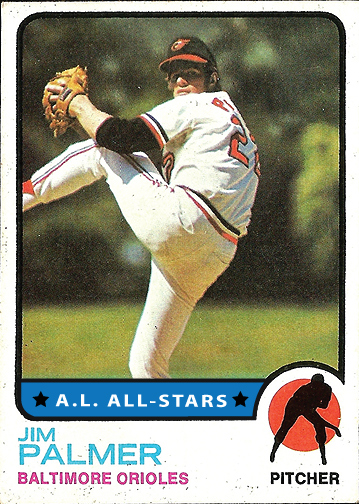
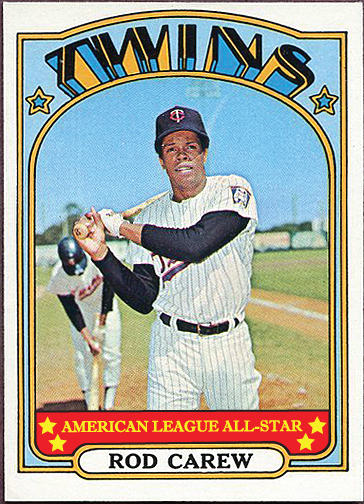
Today I give you what I'd like to think the 1972 Topps cards would have looked like had they designated all stars as they would later in the decade, between 1975-1981.
Instead of an separate "all star" sub-set, the players would be tagged all stars on their regular issue cards.
I went with a simple bar-design running across the bottom of the card, just above the player's name. The A.L. got a red bar, while the N.L., which I will post tomorrow, got green.
Again, these are the players that were voted to the starting line-up, so even though Ray Fosse, Boog Powell and Tony Oliva didn't play because of injuries, they still get the all star tag-line.
Of course, Reggie Jackson, who didn't get voted in as a starter, was the player with the biggest impact on the 1971 All Star game, hitting a mega-blast off the light tower that instantly became legendary.
As a matter of fact, this game featured six home runs, and ALL six were hit by future Hall of Famers: Frank Robinson, Reggie Jackson, Harmon Killebrew, Johnny Bench, Roberto Clemente and Hank Aaron.
Frank Robinson's homer made him the first player to ever hit home runs as a member of both leagues.


Tuesday, June 18, 2013

THE MISSING ALL-STAR CARDS: 1971 TOPPS: NATIONAL LEAGUE

Today we have the 1971 Topps National League all stars "that never were".
For the N.L. players who were elected starters in 1970, I used a yellow border and star to designate "all star" status, as opposed to the red I used on the A.L. guys.
A couple of items of note: Rich (Dick) Allen is shown on his card as an outfielder even though he was voted in as the starting 1st Baseman. Also, as I profiled before: this is the first Topps baseball card showing a player with a mustache. Ever. Incredible after 20 years of producing cards at that time.
For Tom Seaver this would have been his only all star card until 1982, when he was on Cincinnati. Pretty amazing when you think about it. For all his domination in the 1970's, it was guys like Dock Ellis, Randy Jones, Andy Messersmith and Jerry Reuss that got all star starts over him.
Chicago was well represented with their middle infielders: Glenn Beckert and Don Kessinger. Of course, this was before the "Big Red Machine" dominated all star voting pretty much the rest of the decade.
Rico Carty was voted in for the 1970 game due to his white-hot hitting, ending the season as the N.L. batting champ with a super .366 batting average to go along with 25 homers and 101 R.B.I.'s.
Tomorrow I'll have the A.L. starting nine depicted on the 1972 Topps set, followed by the N.L. team on Thursday.


FOLLOW ME ON TWITTER...

@wthballs
Everything baseball: cards, events, history and more.