Thursday, March 7, 2024

1969 "DO-OVER" SET: JIM BUNNING

Today on the blog, we spotlight my "do-over" for Hall of Fame pitcher Jim Bunning and his 1969 card, from my custom 1969 "Gimmie-A-Do Over" set released a few months ago:


Really happy to finally "fix" a bunch of the cards from my birth-year set that saw Topps reuse images from previous years, or use an image that was terribly outdated due to a licensing issue with the MLBPA.
As a baseball player he put in 17-years of all-star play, winning 20 games once, but putting together four 19-win seasons along with three 17-win seasons, while leading his league in strikeouts three times and shutouts twice.
The seven-time all-star threw a no-hitter in each league, with his National League no-no a perfect game against the New York Mets in 1964.
He also won 100-games in each league, becoming the first to do so since the great Cy Young at the beginning of the 20th Century.
In 1996, he was inducted into the Hall of Fame, joining contemporaries such as Juan Marichal, Sandy Koufax and Whitey Ford.
By then he was already a Representative of Kentucky’s 4th District  for nine years before becoming a State Senator in 1999, a position he would hold until January 2011.
A great life to say the least. Though I like to think of it as incredible actually. To do any ONE of these things he accomplished is a life’s great achievement, and Bunning did them all.
Amazing man.

Wednesday, March 6, 2024

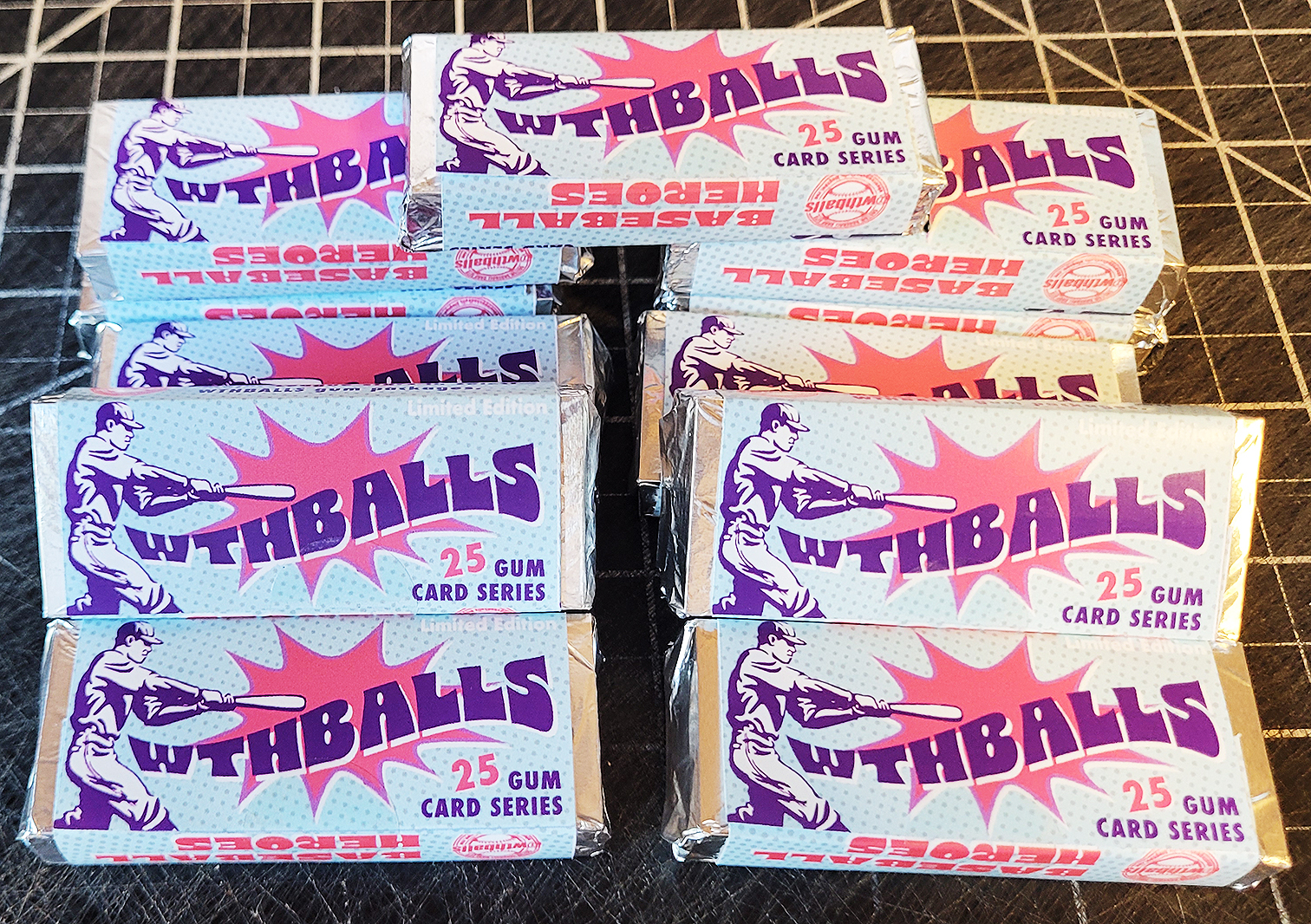
WTHBALLS GUM PACK CUSTOM SET: REGGIE JACKSON

Good day everyone.
On the blog today, my Reggie Jackson mini-card from my recent custom "Gum Pack" set, released in unique packaging:


Just a fun little set I worked on between "regular" releases to keep things interesting!
Truly one of the eternal icons of the game, the man was just destined for baseball greatness since his days at Cheltenham High School in Pennsylvania.
Recruited by pro teams and colleges alike, he went on to Arizona State where he was actually on a football scholarship.
Of course we all know the story of the 1966 amateur draft, where the New York Mets held the #1 pick, and opted for high school catcher Steve Chilcott instead of who many considered the true #1 overall amateur, Jackson.
With the second pick, the Kansas City Athletics (later Oakland) picked the slugger and the rest is history, as he would eventually lead the organization to three straight championships between 1972-1974 before being traded in a blockbuster to the Baltimore Orioles where he’d play for one season in 1976.
As a highly coveted free agent before the 1977 season, Jackson signed with the New York Yankees, and with Reggie in NYC, the legend exploded as he helped the Yankees to two championships in 1977-78.
With his larger than life persona, New York ate it up and before you knew it, he was known around the world, even getting his own candy-bar by the end of the decade.
For a kid like me growing up in Brooklyn in the ‘70’s, Reggie was like a God, larger than life, and before he finished up his career in 1987, putting in 21 seasons, he would put together a Hall of Fame career with 563 homers, 1702 runs batted in, an MVP Award in 1973, and five championships.
Add to that 14 all-star nods, four home run titles, a legendary homer in the 1971 All-Star Game against Dock Ellis, his 1977 World Series performance, and you can see why he goes down as one of the most well-known baseball personalities the game has ever seen!


Tuesday, March 5, 2024

NOT REALLY MISSING IN ACTION: 1978 DAN THOMAS "THE SUNDOWN KID"

On the blog today, a card I meant to create years ago, but would flip-flop about because of the troubled player depicted, a "not so missing" 1978 card for the "Sundown Kid", Dan Thomas of the Milwaukee Brewers:


Thomas appeared in what ended up being the last 22 games of his short MLB career in 1977, hitting a respectable .271 after hitting .276 in his rookie year of 1976, when he appeared in 32 games.
Coming into the 1977 season, Thomas, who recently joined the "Worldwide Church of God" and began strictly observing the Sabbath, notified the club that he would NOT play on the Sabbath, earning him the nickname mentioned earlier.
The media played the situation up somewhat, even leading Thomas to being featured in People Magazine, where he is quoted as stating, "If I'm good at baseball, it's only because God gave me the talent. I'll give it all I've got, but I won't play on the Sabbath."
Even though the young hitter was hitting .271, he was still demoted to the Triple-A Spokane Indians, with one columnist stating that "No matter how tolerant and ecumenical Brewers' management wants to be, they are irked by having a player sit out two games a week".
Thomas' relationship further deteriorated after he even agreed to a pay cut of one day a week while with Spokane, refusing another demotion to their Eastern League affiliate in August after a decline in performance, prematurely ending his season.
Brewers' President Bud Selig even chimed in on the matter, stating "It's just a tragic story. I know a lot of people are mad at us because of what they think we've done to him...He's really a nice kid who wants to do the right thing."
From there, Thomas' pro career was essentially done, as he was unsuccessful in later attempts to latch on with other organizations.
He'd go on to play for the Independent Boise Buckskins in the Northern league, where he'd actually win the Class-A batting title in 1978, before putting in some time with the Miami Amigos of the Inter-American League in 1979 before quitting baseball all together shortly after.
Things took an even more terrible turn for him when, in June of 1980 Thomas was arrested on a rape charge involving a 12-year-old girl in Mobile, Alabama.
While in jail on the rape charge, Thomas committed suicide by hanging, with his family so poor that they couldn't even afford a proper funeral, leading him to be burried in a "Potter's Field".
Thomas had a history of mental health problems, even taking to drink and pills to combat his inner-demons in the mid-70s.
In 1976 while in Venezuela, he was even hospitalized after overdosing on pills, telling his wife, "...I wish I had cancer, then at least people would realize what was the matter with me."
Just a tragic story all-around.

Monday, March 4, 2024

1960S "IN-ACTION": 1969 PETE ROSE

The next card profiled here on the blog from my recent custom "1960s In-Action" set is my 1969 card for the all-time hit king, Pete Rose:


Great evening shot of the young rose, who was the reigning N.L. batting champ when this card would have come out.
Rose was was also about to take home his second straight batting title, hitting .348 after a league-leading .335 in 1968.
He would also reach 200+ hits for the fourth of what would end up being a record ten such seasons, with 218 in 1969.
Those numbers got him a fourth place finish in the MVP race at season's end, along with a Gold Glove for his work in the outfield after coming up as a second baseman.
Growing up in the 1970's as a baseball nut, Pete Rose was an almost mythic figure. Even though his Reds steamrolled through "my" Yankees in the 1976 World Series, Rose, along with his all-star teammates, seemed like something made-up, not real.
I guess a part of that could be that the very first Pete Rose baseball card I ever saw, at the age of seven, was his 1976 Topps masterpiece, which had that glare of his, staring down the camera, showing that intensity that created the "Charlie Hustle" legend.
What a player, a Hall of Fame player. But I won't get into THAT here.
The "Player of the Decade" for the 1970's, Rose etched his name into the history of the game many times over.
Really, along with guys like Tom Seaver and Reggie Jackson, you just can't have too many Pete Rose cards from the 1970's in my eyes.

Sunday, March 3, 2024

MISSING ALL-STAR MANAGER: 1977 SPARKY ANDERSON

On the blog this fine day, my "missing" 1977 National league Manager card for Sparky Anderson, who guided the N.L. to another win in the All-Star game in 1976, something he'd do again the following season:


Arguably leading the team of the decade, the Cincinnati Reds, Anderson was at the helm of a team that featured many of the top players of the era when this card would have seen the light of day.
In 1975 the Reds were arguably one of the best teams in baseball history, steamrolling to 108 victories before eventually beating the Boston Red Sox in the World Series.
In 1976, more of the same as the team would win 102 games before sweeping the New York Yankees in the World Series.
Throw in the fact that they were also in the World Series in both 1970 and 1972, and it really looked like the team, stacked with guys like Johnny Bench, Pete Rose, Joe Morgan and George Foster, would be keeping our attention for quite some time.
But alas, according to Sparky, it was the trading of one of their OTHER stars, Tony Perez, that took the heart and soul out of the team, and shockingly the "Big Red Machine" would not bring home another championship, and the franchise would have to wait until 1990 before experiencing it again.
For Anderson however, the man would go down as one of the greatest managers in Major League history, moving on to the Detroit Tigers in 1979, where he would go on to manage 17 years, giving him a combined 26 years of Big League managing, even taking home another title with that great 1984 Tiger team that was in first "wire-to-wire", winning 104 games before beating the San Diego Padres in the World Series.
All told the man won 2194 games as a manager, finishing with a .545 winning percentage, three titles, 5 pennants, and of course a Hall of Fame induction in 2000.
Legend, and perpetually looking like an "old man" even when he was in his 30's!

Saturday, March 2, 2024

1960S ALL-DECADE TEAM: A.L. CATCHER BILL FREEHAN

Today on the blog, my pick for the American League Catcher of the 1960s, Detroit Tiger legend and "should-be" Hall of Famer Bill Freehan:


It's safe to say that between Berra and Fisk, Freehan was easily the best catcher in the American League.
With all the superstars on the filed during the decade, it's easy to forget that Freehan was an eleven-time all-star, five-time Gold Glover, and finished in the top-ten in M.V.P. voting three times, with a second place finish in 1968 behind teammate Denny McLain.
1964, his first full year in the Majors, was arguably his finest season, as he hit .300 for the only time in his career along with 18 homers and 80 R.B.I.'s.
But for the rest of the decade Freehan put up comparable numbers year after year, while taking are of a Detroit pitching staff that featured guys like McLain, Mickey Lolich and Earl Wilson.
He really was ahead of the rest of the pack as far as A.L. catchers during the decade.
A solid player through and through, he'd retire after the 1976 season with a .262 lifetime average, 200 homers and 758 runs batted in over 1774 games and 6073 at-bats.


Friday, March 1, 2024

MINOR LEAGUE DAYS: LEGENDS EDITION- LOU GEHRIG

Good day all!
On the blog today, we add the great, if not greatest, first baseman of them all, Lou Gehrig, to my on-going "Minor League Days: Legends Edition" set, which I hope to print up as a custom release later in the year:


We see the young future legend suited up with the Hartford Senators of the Eastern League, for whom he played parts of three seasons with between 1921 and 1924.
Of the stats available from that tenure, we see Gehrig already showing signs of what he would do once he made it to a Big League field, as he hit .369 with 37 homers and 186 hits in 1924 over 134 games at the age of 21.
Of course, once he DID make it up to the Majors for good in 1925, he was there to stay, putting together one of the greatest careers a ballplayer would have.
His statistics are mind-blowing, as he would drive in 100+ runs 13 straight seasons, with a high of 185 in 1931 which is still the American League record.
He would score 100+ runs 13 straight seasons with a high of 167 in 1936 when he took home an MVP Award.
He would top 200+ hits eight times over his 14 full seasons, with 40+ doubles seven times, 10+ triples nine times, a .350+ batting average six times, 400+ total bases a ridiculous five times, and a Triple Crown in 1934 when he hit .363 with 49 homers and 166 RBIs.
Again, just ridiculous numbers, and especially so remembering that Babe Ruth batted AHEAD of him for most of his career!
Certainly MY favorite player of all-time.
If only we could have had him play out his career naturally, and not lose him to ALS at the young age of 37 in 1941.


FOLLOW ME ON TWITTER...

@wthballs
Everything baseball: cards, events, history and more.