Showing posts with label Turn Back The Clock. Show all posts

Sunday, April 12, 2026

REVISIT: 1978 "TURN BACK THE CLOCK" STAN MUSIAL

Up on the blog today, thought it'd be fun to revisit another 10-year-old post, this one my 1978 "Turn Back The Clock" card for all-time great Stan Musial, celebrating his 3000th hit from 20 years earlier:


He would go on to collect another 630 more hits to become the leading National League hit-maker before Hank Aaron would overtake him about 10 years later.
Throw in 725 doubles, 177 triples and 475 home runs and you have yourself one of THE best all-around hitters the game ever saw.
Three Most Valuable Player Awards, FOUR second-place finishes, including three in a row between 1949-1951, and twenty consecutive all-star appearances, Musial definitely is a member of that rarified stratosphere of baseball royalty along with the likes of Ruth, Cobb, Mays and Wagner, among others.


Wednesday, May 15, 2024

REVISITING A BLOG POST FROM 2015: ALLIE REYNOLD'S TWO NO-HITTERS

On the blog today, we revisit a blog post from November of 2015 celebrating Allie Reynolds and his two no-hitters of 1951 on a 1971 "Turn back the Clock" card:


Here's the original write-up for the post as it appeared back then:
Today we celebrate Allie Reynolds and his two no-hitters in 1951, which he threw against the Cleveland Indians and the Boston Red Sox, in my “Turn Back The Clock” series.
The “Super Chief” had it going on in 1951, winning 17 games and leading the league with seven shutouts.
On July 12th of that year he faced his old team, the Indians, and beat them 1-0 thanks to a solo home run by Gene Woodling. He retired the last 17 batters he faced, and his rival pitcher, Bob Feller, pitched a no-hitter himself just eleven days earlier!
On September 28th, he faced Boston and easily beat them 8-0, which allowed the Yankees at least a tie for first in the American League.
Reynolds struck out nine and walked four, and of course we all know that the final batter he faced was none other than Ted Williams, arguably the greatest all-around hitter in baseball history.
All Reynolds had to do was, in a sense, retire him TWICE, as Yogi Berra dropped a foul pop-up for the final out, before catching the very next one, as Williams popped out to end the game.
Only six pitchers have thrown two no-hitters in one season, with Roy Halladay (2010) and Max Scherzer (2015) being the most recent to the exclusive club.


Wednesday, November 2, 2022

TURN BACK THE CLOCK: 1975 ROGERS HORNSBY AND HIS SECOND TRIPLE CROWN

Up on the blog today, let's stick to the topic of Triple Crowns in my on-going "Turn Back the Clock" thread and celebrate the great Rogers Hornsby on a 1975 edition, on the 50th anniversary of his second Triple Crown season of 1925:

 
The man was just plain ridiculous at the plate that year, leading the National League with his 39 homers, 143 runs batted in and a cool .403 batting average, his THIRD .400 season in four years!
As stated, he TWICE took home a Triple Crown (in 1922 and 1925), and was the first National League player to hit over 40 homers in a season when he smashed 42 in 1922.
He batted over .400 three times, topped by an astounding .424 average in 1924, and just missed out on another when he hit .397 in 1921.
By the time he retired as a player, he took home seven batting titles, two home run titles, and four RBI titles, along with two MVP Awards and the second highest career average (N.L./A.L.) to this day, at .358.
I have forever been fascinated by his 1922 season, when he scored 141 runs, collected 250 hits, rapped out 46 doubles, 14 triples and 42 homers, drove in 152 runs, and hit an astounding .401 with 450 total bases.
Absolutely absurd and one of the greatest single-season performances the game has ever seen!

Tuesday, October 18, 2022

TURN BACK THE CLOCK: 1947 TED WILLIAMS

Up on the blog today, we have a 1972 "Turn back the Clock" card celebrating the great Ted Williams and his SECOND Triple Crown season:

 
The man was a hitting machine!
All he did during that historic 1947 campaign was lead the American League with 125 runs scored, 32 homers, 114 runs batted in and a .343 average, along with a .499 on-base percentage and a .634 slugging percentage, YET finished second behind the New York Yankees Joe DiMaggio for the MVP Award. Total joke!
Just five years before that he also took home the Triple Crown when he led the league with 141 runs scored, 36 homers, 137 RBIs and a .356 average, this a year after he hit .406 in the legendary 1941 season.
Easily the greatest all-around hitter the game ever saw, Williams took home six batting titles, four home run titles and four RBI titles over his career, a career that saw him lose five seasons because of military service because of World War II and the Korean War.
Just incredible to think he could have reached 700 home runs, 2000+ RBIs, 2000+ runs scored and 3500 hits if not for time lost for reasons other than injury.
I will forever be in awe of this man and what he accomplished both on and off the playing field.

Tuesday, October 11, 2022

TURN BACK THE CLOCK- 1977 50TH ANNIVERSARY FOR BABE RUTH

By special request today, I post up a 1977 "Turn Back the Clock" card celebrating the 50th anniversary of Babe Ruth and his 60 home runs, something appropriate for 2022 as Aaron Judge climbs up the A.L. all-time season list:

 
As we all know, Ruth topped what many thought was his own record of 59 home runs in 1921 with 60 in 1927, putting in a season of the ages, scoring 158 runs, driving in 165, hitting .356 and slugging .772 for the "Murderer's Row" champion Yankee team that won 110 games and is still regarded as one of the all-time best teams.
The man was mythical, playing so far above and beyond his contemporaries that it made his arguably the most famous person on earth, let alone in America.
I'm not a fan of all this talk today diminishing all that Ruth did over his career, as I believe the entire concept of "context" has been lost on those that like to say things like "...if he played today...".

Saturday, September 10, 2022

TURN BACK THE CLOCK: 1978- 20TH ANNIVERSARY OF WEST COAST MAJOR LEAGUE BALL

Today on the blog I thought it’d be fun (yet still painful for many here in the NYC area) to create a 1978 “Turn Back the Clock” card celebrating the debut of West Coast baseball in the Major Leagues, with the sudden departure of both the New York Giants and Brooklyn Dodgers from the New York metropolitan area over the off-season:


As we all know by know, after failed negotiations with the city and state for new and improved “modern” ballparks, the owners of both much-loved New York City National League teams agreed to take the organizations West, the Giants to San Francisco and the Dodgers to Los Angeles, leaving a HUGE hole in the hearts of many.
Both teams did flourish in their new digs, becoming powerhouses with stars like Willie Mays, Duke Snider, Sandy Koufax, Willie McCovey et. Al, lending the aura of the West Coast an even larger presence in American culture through the early-70’s.
On April 15th, 1958, the Dodgers squared off against the Giants, with San Francisco winning the game 8-0 on a Ruben Gomez shutout, in the very first game played on the West Coast in Major League history, played at Seal’s Stadium in San Francisco.
I can’t even imagine what this must have been like for Dodger and Giant fans here on the East Coast, crushed by the reality of their teams now located over 3000 miles away.

Friday, November 20, 2020

TURN BACK THE CLOCK- 1954: KARL SPOONER'S ELECTRIC MAJOR LEAGUE DEBUT

I realized I haven’t created a “Turn Back the Clock” card in a long while, and recently was reminded of Brooklyn Dodger pitcher Karl Spooner’s incredible Big League debut on September 22nd, 1954.
So without further delay, here you go:


On that September day, Spooner took the mound for the Dodgers a day after the New York Giants clinched the National League title on their way to a World Championship.
All the young lefty would do that day is shut out the Giants on three hits while striking out 15 batters, while walking three, setting a new MLB record for K’s in a debut.
In addition to that, he would also set a new record with six straight strikeouts over the seventh and eighth innings, by now on cruise control as he was heading towards his amazing complete game.
In his very next start, now against the Pittsburgh Pirates, he would again put in an electric performance, striking out 12 batters, a new National League record (one short of Bob Feller’s MLB record of 28 K’s in successive starts), while posting his second straight shutout.
Not too shabby!
The next season Spooner was a highly anticipated rookie who had Dodger fans waiting for magical season, but as we have seen over and over again, the unexpected happened as he was rushed into a Spring Training game to relieve starting pitcher Johnny Podres.
In warming up too fast so as to be ready when the signal came, Spooner later recalls that he entered the game and felt a slight pull on his throwing shoulder.
Though he didn’t think anything of it at the time, by the time his day was over and he was in the dressing room, it got to the point where he couldn’t even put his shirt on.
And just like that, though he did pitch the rest of the season, appearing in 29 games while going 8-6 with a 3.65 earned run average over 98.2 innings, the damage was done, and he never pitched another Major League game again.


Saturday, September 2, 2017

TURN BACK THE CLOCK 1969- STEVE CARLTON STRIKES OUT 19 BATTERS

Today we celebrate the great Steve Carlton and his 19-strikeout game on September 15th of 1969, the real first glimpse of the greatness to come over the next 15 years:


Ironically enough, Carlton actually lost the game, because of Ron Swaboda's TWO two-run home runs which gave the Mets all the runs they needed to beat Carlton and the Cardinals, 4-3.
However Carlton had it all working for him that day, as he marched right into the record books by beating the previous record of 18 strikeouts which was jointly held by Bob Feller, Sandy Koufax and Don Wilson.
This was pretty much the first historic highlight of the future Hall of Famer's stellar career, as he'd go on to then post his first 20-win season in 1971 while still with the Cardinals, then post his uber-famous 1972 Triple-Crown winning year as a Philadelphia Phillie, winning his first of four Cy Young Awards.
Carlton would end his 24 year career with 329 wins, 55 shutouts, a 3.22 earned run average and a whopping 4136 strikeouts.
Those monster numbers got him inducted to Cooperstown on his first try in 1994, getting named on 436 of 456 ballots.
I remember seeing Carlton pitch at the end of his career when he was trying to hang on those last couple of years.He pitched for the Cleveland Indians against the New York Yankees at the Stadium on April 14th, 1987, giving up a grand slam homer to Yankee catcher Joel Skinner, and eventually taking the loss.
It was kind of a bummer, as he was a shell of his former self, and was caught in that vicious "hanging on" phase some players tend to get stuck in.
He'd move on to Minnesota later that year, and even pitch in four games for them in 1988 before finally hanging them up, putting to rest an incredible baseball resume that only a couple of other lefties can match in the history of the game.

Sunday, August 27, 2017

TURN BACK THE CLOCK 1969- WILLIE MAYS SLUGS HIS 600TH CAREER HOME RUN

Just four seasons after clubbing his 500th career home run, Willie Mays was at it again in 1969, smashing his 600th career homer, so let’s celebrate that feat with a 1979 “Turn Back the Clock” card:


Mays became only the second player all-time to reach the lofty height, joining Babe Ruth and eventually retiring with 660 homers.
And if it wasn't for military service in 1952-53, he easily would have been the second "700 Homer" guy, beating Aaron to the finish line by a couple years for sure.
As we all know, there would be quite a few more players joining Ruth, Aaron and Mays with 600+ homers decades later.
But if you were a kid growing up in the 1970's and '80's, those three were the "Mount Rushmore" of home run power, forever burned into our minds.
Ruth…Aaron…Mays.
Classic…

Friday, August 18, 2017

TURN BACK THE CLOCK-1969: BACK TO BACK NO-HITTERS BY JIM MALONEY & DON WILSON

Just one season after the Major Leagues saw opponents no-hit each other when Gaylord Perry and Ray Washburn pulled off the trick during the “year of the pitcher”, the improbable happened when two pitchers managed to do the very same in 1969, Jim Maloney of the Cincinnati Reds and Don Wilson of the Houston Astros.
Here’s a 1979 “Turn Back the Clock” celebrating that feat:


On April 30th, Reds fireballer Jim Maloney pitched what was considered then his third career no-hitter, beating the Astros 10-0 after striking out Doug Radar for the last out & his 13th strikeout of the day.
This was an Astros team that had Joe Morgan and Jimmy Wynn in the line-up, so it wasn’t exactly a piece of cake, though Maloney was credited with facing only 26 official batters after the Reds pulled off a double-play to erase of of five walks the hurler issued that game.
Now, years later in 1991 when baseball changed the rules, Maloney had one of his no-hitter taken away when it was now not considered a no-no if you eventually gave up a hit in extra-innings, which is exactly what Maloney did against the Mets in June of 1965 when Johnny Lewis tagged Maloney for a homer in the 11th inning of what was, up to that point, a no-hitter.
Nevertheless, Maloney went down in history as a two-time no-hit pitcher, three if you want to count that Mets game, and wouldn’t you know it, the very next day the Astros would send to the mound a guy who would also end up with multiple no-hitters during his strong, though tragic career, Don Wilson.
Facing a strong Reds line-up that included Johnny Bench, Tony Perez and the eventual N.L. batting champ that season, Pete Rose, Wilson would fan 13 and walk six, but keep Cincinnati hitless for the no-hitter, and baseball history in the Astros 4-0 win.
Wilson would also finish his career with two no-hitters, famously losing a possible third when his manager, Preston Gomez, took him out for a pinch-hitter on September 4th 1974 with the team trailing 2-1 to the very same Reds, eventually losing the no-hitter and the game.
Sadly, however, just a few months later on January 5th 1975, Wilson was found dead behind the wheel of his car in his garage, overcome by exhaust fumes, which also tragically killed his five-year-old son who was sleeping in a bedroom above the garage.

Sunday, August 6, 2017

TURN BACK THE CLOCK: 1969- THE "MIRACLE METS"

Next in my “Turn Back the Clock” running thread is the wonderful “Miracle Mets” season of 1969, just about as amazing (pun intended) a turnaround for a franchise as you could imagine:


After a ninth-place finish in 1968 with a record of 73-89, the Mets shocked the sports world in 1969 when they marched to a record of 100-62, led by a pitching staff that would make most envious with the likes of Tom Seaver, Jerry Koosman, Nolan Ryan and Gary Gentry.
Of course the road wasn’t easy, as they had the Chicago Cubs to deal with, and with the newly placed play-off format that did not ensure a pennant for coming in first, they had to go on to play the Atlanta Braves in the first National League Championship playoffs.
But again, the Mets were here to shock us all, as they swept the Braves and were to face the American League juggernaut Baltimore Orioles, who put together one of the most dominant team seasons of the modern era when they stormed to a record of 109-53, then sweeping the American League West champ Minnesota Twins 3-0 in the playoffs.
However, 1969 was all about the Mets, as they proceeded to take the series, and the World Championship 4 games to 1, giving New York an unlikely championship that was also paired with the New York Jets Super Bowl III win and the New York Knicks NBA championship, a brilliant sports trifecta the Big Apple could boast about until this very day.

Saturday, July 29, 2017

TURN BACK THE CLOCK-1968: BACK-TO-BACK NO-HITTERS!

Today’s “Turn Back the Clock” card celebrates those two straight magical days in September, 1968, when Gaylord Perry no-hit the St. Louis Cardinals, only to have Cardinals pitcher Ray Washburn return the favor the very next day:


Of course, being the “year of the pitcher”, anything regarding pitching feats was possible (can you imagine if Koufax was still playing that season?!), but two straight no-no’s? Just amazing!
On September 17th, Gaylord Perry faced none other than pitcher of the universe that season, Bob Gibson.
But it would be Perry to come out on top that day, (helping to explain just HOW Gibson could have lost nine games that year), allowing only two balls hit out of the infield that day, winning the game 1-0 on a home run by none other than Ron Hunt in the first inning!
Perry walked two, while striking out nine on his way into the baseball record books, collecting his 15th win of the season and lowering his earned run average to 2.46.
Not to be outdone, and with the National League pennant already in the bag for the Cardinals, Ray Washburn took to the mound the very next day and kept the Giants hitless himself, though walking five batters.
Curt Flood and Mike Shannon each drove in a run, giving Washburn all the offensive support he needed that historic day.
What is amazing is that he lowered his ERA to a sparkling 2.28 to go along with Gibson’s incredible 1.13, yet the Giants losing pitcher that day was none other than Bobby Bolin, who allowed two runs to the Cardinals, “ballooning” HIS ERA to 1.96!
Again, the “year of the pitcher” indeed!
Imagine getting to see that season unfold! Wish I could have...

Saturday, July 22, 2017

TURN BACK THE CLOCK- 1968: HANK AARON SLAMS HIS 500TH HOME RUN

Next up on my “Turn Back the Clock” series is a 10th Anniversary 1978 card celebrating “Hammerin’” Hank Aaron and his 500th career home run, on his way to 255 more to end up as the Major League’s all-time home run champ with 755:


On July 14th of ‘68, Aaron came into the game against the San Francisco Giants with 499, until he connected off of reigning National League Cy Young winner Mike McCormick in the third-inning for a three-run shot.
Of course, playing for the other team was Willie Mays, who was (at the time) one of only six players with 500+ homers in MLB history, along with Aaron’s former teammate Eddie Mathews, who reached the milestone the previous season while with the Houston Astros.
Of course, even though Aaron was already 34 years old, he wasn’t nearly done, as he’d go one to post five consecutive 30+ homer seasons, with three of them more than 40, including what would end up being a career-high 47 in 1971 at the age of 37!
The man was not just about homers however, as evidenced by his 3771 hits, 2174 runs scored, 624 doubles and 2297 runs batted in along with a .305 career average.
All...Time...Great!

Sunday, July 9, 2017

TURN BACK THE CLOCK-1968: DON DRYSDALE'S INCREDIBLE SHUTOUT STREAK

Next up in my on-going “Turn Back the Clock” series is 1968 and Don Drysdale’s amazing shutout streak, a record that remained intact until another Dodger pitcher, Orel Hershiser, topped it exactly 20 years later:


Drysdale was coming towards the end of his Hall of Fame career in 1968 because of a chronically sore shoulder, but in May & June of 1968 he was just incredible, tossing six straight shutouts, on his way to 58 2/3 shutout innings pitched, topping Walter Johnson’s 55 2/3 innings in 1913.
Ironically, just about as Drysdale’s streak was ending, one of the other longest such streaks began, as St. Louis Cardinals’ pitcher Bob Gibson began a 47-inning stretch of shutout ball that encompassed the entire month of June.
Drysdale would finish the season with a record of 14-12, with a 2.15 earned run average and eight shutouts over 31 starts, 12 of them completed.
The following year, because of his constant shoulder pain, Drysdale decided to retire after going 5-4 with a 4.45 E.R.A. over 12 games, finishing his career with 209 wins and a very nice 2.95 E.R.A., with 49 shutouts and 2486 strikeouts in 14 Major League seasons.

Saturday, July 1, 2017

TURN BACK THE CLOCK 1968: JIM HUNTER TOSSES PERFECT GAME

Today we celebrate Jim “Catfish” Hunter’s perfect game from May 8th, 1968 versus the Minnesota Twins:


The future Hall of Fame pitcher held the hard-hitting Twins in check, which is amazing when you consider this line-up consisted of: 10 batting championships, 6 homer champions, and nine total-hits champions!
The Twins line-up that day had Rod Carew, Tony Oliva, Cesar Tovar and Harmon Killebrew as the first four batters! Incredible to think Hunter mowed them down one by one.
What is often forgotten is that the hitting star that day for the Oakland Athletics was none other than Hunter himself, going 3-for-4 at the plate with three RBI’s in the 4-0 win.
Of course, at the time Hunter was just a 22-year old .500 pitcher for the organization, a few years before he’d become the five-time 20-game winner we all remember.
It was the 1st regular season perfect game in the American League since Charlie Robertson tossed one in April 30, 1922 for the White Sox in their win over the Detroit Tigers.

Saturday, June 24, 2017

TURN BACK THE CLOCK- DENNY McLAIN DOMINATES IN 1968, WINS 31 GAMES

Next up in the “Turn Back the Clock” series is a 1978 card celebrating the 10th anniversary of Detroit Tigers pitcher Denny McLain and his incredible season which saw him win 31 games, the last pitcher (ever?) to do so:


While the Tigers were on their way to a World Championship, the 24-year old McLain led the way anchoring the staff with an incredible 31-6 record, along with a 1.96 earned run average, 280 strikeouts, six shutouts and completing 28 of 41 starts!
Not only was that good for the Cy Young Award, but he also took home the Most Valuable Player Award as well.
Of course 1968 will forever be known as the “Year of the Pitcher”, but it does not take away from what McLain accomplished.
He would lead the league in wins, winning percentage, complete games and innings pitched that year, and would follow it up with another Cy Young season in 1969 when he posted a 24-9 record along with a 2.80 E.R.A., nine shutouts and 181 strikeouts in 41 starts.
What an amazing run!

Wednesday, June 14, 2017

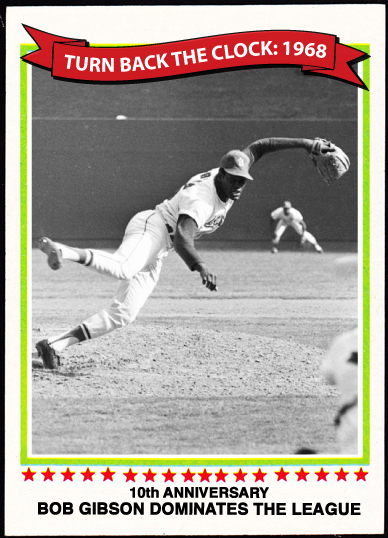
TURN BACK THE CLOCK: BOB GIBSON'S INCREDIBLE SEASON OF 1968

The next “Turn Back the Clock” card in the long-running series is a 10th Anniversary card for the season of the ages Bob Gibson had in 1968. A season that saw him bring home the hardware, dominate his league, and carve his name into the annals of baseball greatness:


Coming off of a championship season in 1967 that saw him appear in only 24 games due to an injury, Gibson jumped right back into his 20-game winning form of 1965 & 1966, besting his career mark of 21 wins with 22, but it was the stinginess of his season that made him a legend.
All Gibson did was complete 28 of 34 starts for the Cardinals, while throwing THIRTEEN shutouts while leading the National League in earned run average with a little-league-like 1.12, as well as pacing the Senior Circuit with 268 strikeouts.
How on earth he LOST 9 games to finish at 22-9 is beyond me, and I’ve gone over the box scores. Just an amazing year!
Think about it, 13 of his 22 wins were shutouts! He attained the 1.12 E.R.A. while pitching 304.2 innings!
Needless to say, by the time Awards season came around he took home the league’s Cy Young, Most Valuable Player, Gold Glove and an All-Star nod.
He was all-WORLD that year!
He would also put together another two 20-win seasons after ‘68, on his way to 251 for his career while topping 3000-K’s, becoming only the second player to do so in Major League history at the time, joining the great Walter Johnson.
In 1981, to put the cherry on top of the cake, he was inducted to the Baseball Hall of Fame, closing the books on one of the great pitchers of his or any era.

Wednesday, May 31, 2017

TURN BACK THE CLOCK- EDDIE MATHEWS SLAMS HIS 500TH CAREER HOME RUN

Next up in my running “Turn Back the Clock” series is Hall of Fame slugger Eddie Mathews and his 500th career home run, hit while he was a member of the Houston Astros on July 14th 1967:


At the time Mathews became only the seventh 500-HR hitter in Major League history, on his way to 512 homers in his 17-year career, spent mainly with the Braves organization from Boston, to Milwaukee, on to Atlanta.
A beast of a hitter immediately upon reaching the Majors, in 1953 he hit 47 homers along with 135 runs batted in at the age of 21!
It would be the first of three straight 40-HR seasons, as well as nine straight 30+ homer campaigns, 10 overall.
By the time he retired after the 1968 season he easily wrote his way into Cooperstown, elected in 1978 with just under 80% of the vote.

Sunday, May 14, 2017

TURN BACK THE CLOCK- 1967 MICKEY MANTLE HITS HIS 500TH HOME RUN

The newest “Turn Back the Clock” card in my thread is a 1977 card celebrating the 10th anniversary of the great Mickey Mantle’s 500th career home run, which occurred on May 14th of ‘67:


In the 7th inning of a Sunday game against the reigning World Champion Baltimore Orioles, Mantle slammed a two-out shot off of reliever Stu Miller to join the (then) exclusive club, on his way to a career 536 homers before he retired in the Spring of 1969.
He would top 50 homers twice during his 18-year career, along with four 40+ seasons and nine 30+ seasons, leading the league four times while also topping the Junior Circuit in runs scored five times and RBI’s once (during his Triple Crown 1956 campaign).
The 16-time all-star and three-time MVP became an American icon that still resonates today, as arguably the most popular subject in card-collecting and as beloved a New York athlete as anyone can name.

Saturday, March 4, 2017

TURN BACK THE CLOCK- 1966 ORIOLES STUN THE DODGERS WITH A WORLD SERIES SWEEP!

Today’s “Turn Back the Clock” moment is more like “moment(s)”, as we celebrate the Baltimore Orioles and their magical 1966 season which ended with a World Championship by SWEEPING the reigning champion Los Angeles Dodgers:


Led by Triple Crown winner Frank Robinson, who came over in a blockbuster deal before the season, the Orioles had a young pitching staff that would not disappoint, led by their “aged veteran” Steve Barber who was only 28.
After finishing their season with a 97-63 record, it was on to the World Series against a Dodger teamed anchored by Sandy Koufax and Don Drysdale.
But this year was all about the O’s, as their young staff did the improbable and limited the Dodgers to TWO runs (both scored in the first game) for the ENTIRE series, throwing three straight shutouts to close it out and take home the series win.
The Dodgers were shut out for 33 straight innings, from the fourth inning of game 1 through to the end of game four!
It would be the beginning of a nice run for the organization, as they’d reach the World Series again in 1969, 1970, 1971, with another championship in 1970 against the Cincinnati Reds (who were themselves starting up a dynasty of sorts at that time).

FOLLOW ME ON TWITTER...

@wthballs
Everything baseball: cards, events, history and more.