Sunday, August 7, 2022

EXPANDED LEAGUE-LEADERS: 1977 N.L. RBIs

Up on the blog today, we proceed in my on-going “expanded league-leaders” thread to the top three RBI men of the National league for 1976, on a 1977 imagined card:
 
 
Of course, we begin with Cincinnati Reds slugger George Foster, who put it all together for his first of three straight RBI crowns, leading the league with 121 in 1976.
Foster would put together three straight MVP caliber seasons between 1976 and 1978, actually taking home the award in 1977 after the greatest offensive season of the decade with his 124 runs, 149 RBIs and 52 homers, all leading marks for the N.L., while also hitting .320 with 197 hits for the Reds.
In 1978 he led the league in homers and RBIs again, with 40 and 120 respectively, giving him a sixth place finish in the MVP race by season’s end after his win in 1977 and a second place finish in 1976.
Behind him with 111 RBIs in 1976, none other than Foster’s MVP teammate Joe Morgan, who was also in the midst of an incredible run, leading the league with a .444 on-base-percentage and .576 slugging percentage for the World Champion Reds, while also stealing 60 bases and scoring 113 runs, second in the league only to another teammate, Pete Rose, who scored 130 himself.
In third place with 107 RBIs is Philadelphia Phillies Hall of Fame third baseman Mike Schmidt, who led the league with 38 homers, his third straight home run title, while also scoring 112 runs and swiping 14 bases for the N.L. East champs.
Great expanded card to create showing three of the major thumpers of the National League for the 1970’s, all MVP worthy, comprising an eventual six MVPs between them!
Hope you enjoy the “card”!

Saturday, August 6, 2022

OPC VARIATIONS- 1977 OTTO VELEZ

The next OPC variation to get the spotlight is the 1977 card for Otto Velez, one of the players shown with the new Toronto Blue Jays franchise that was about to begin play that season:

Topps version

OPC version
 
OPC was laying out the red carpet so to speak for the new Canadian team, and with that came better photography for the player cards instead of airbrushed examples when possible.
After playing for the New York Yankees in parts of four seasons between 1973 and 1976, he was drafted by the Toronto Blue Jays in their inaugural expansion draft before the 1977 campaign.
He was the 53rd pick in the 1976 expansion draft, and would have a decent year for the Jays in 1977 when he batted .256 with 16 homers and 62 runs batted in.
He would stay with the team for the next five seasons, hitting as many as 20 homers (1980) as well as matching his 1977 RBI total that very same year.
In 1983 he would find himself with the Cleveland Indians, where he would play what turned out to be the final 10 games of his career, hitting only .080 with two hits over 25 at-bats, with a run scored and an RBI.
Velez would put 11 years in the Major Leagues, batting .251 with 78 homers and 272 runs batted in, while collecting 452 hits in 1802 at-bats over 637 games.

Friday, August 5, 2022

NOT REALLY MISSING IN ACTION- 1979 BRUCE TAYLOR

Up on the blog today, how about a "not so missing" 1979 card for former Detroit Tigers pitcher Bruce Taylor, who appeared in one single game during the 1978 season:

 
Taylor tossed one full inning for the Tigers in 1978, retiring all three batters faced, good for a sparkling 0.00 earned run average.
He appeared in 19 games for the Tigers during the 1977 season in his Big League debut, posting a 1-0 record with a 3.38 earned run average and two saves in 29.1 innings of work.
It was his first taste of the big leagues, and the most active, as he would only appear in the aforementioned single game during the 1978 season, followed by 10 games in 1979, when he posted a 1-2 record with a 4.82 ERA in 18.2 innings.
That would be it for the righty, as he’d finish his Major League experience with a 2-2 record, along with a 3.86 ERA and 27 strikeouts in 49 innings spread out over those 30 games in parts of three seasons.

Thursday, August 4, 2022

1970 "IN-GAME ACTION": HANK AARON

Next up in my on-going 1970 "In-Game Action" series is the great Hank Aaron, all-time slugger and perhaps the greatest of them all:


Aaron was coming off a season that saw him hit 44 homers in 1969, while driving in 97 runs, scoring an even 100 and hitting .300 for the Braves, a "typical" Hank Aaron year.
Those numbers would help Atlanta to a first place finish in what was the first year of division play, with the Braves topping the West and New York Mets leading the East.
Aaron would also end up third in the National League MVP race, his highest finish since 1963 in which he also finished third.
The man was simply out of this world...
Let his numbers do all the talking: 2174 runs scored, 3771 hits, 624 doubles, 98 triples, 755 home runs, 2297 runs batted in, a .305 batting average no less than 21 all-star selections!
Just tremendous!
He also had eight top-5 finishes for MVP, including taking home the award in 1957, as well as three Gold Gloves won consecutively between 1958-1960.
It's incredible to look at his 15 years of topping 100 or more runs scored, 11 seasons of 100 or more runs batted in, five more seasons of 90+ RBI's, and TWENTY STRAIGHT years of 20 or more home runs.

Rest in Peace to one of the absolute greats of the game, Mr. Henry Aaron...aka "Hammerin' Hank"!

Wednesday, August 3, 2022

REVISITING A BLOG POST FROM NOVEMBER, 2014- "DEDICATED ROOKIE": 1974 BILL MADLOCK

Thought I'd go back eight years and revisit my blog post from November of 2014 featuring my "dedicated rookie" of eventual four-time batting champ Bill Madlock:

 
I found this really sweet image of "Mad Dog" batting during the 1974 season, his first in Chicago.
Madlock initially came up with the Texas Rangers at the end of the 1973 season, and was part of the mega-trade that sent former Chicago pitching-ace Fergie Jenkins to the Rangers in October.
Topps did get the "fixes" in time to have a Texas Rangers Jenkins card, while Madlock was portrayed as a Chicago Cub on the multi-player rookie (which I happened to profile the other day as part of my "#600" post!) he made his debut on.
As I stated at the top, Madlock was a four-time batting leader, which is easy to forget sometimes.
He led the National League in back-to-back seasons in 1975 and 1976 with the Cubs, then in 1981 and 1983 while a member of the Pittsburgh Pirates.
In between he put in two and a half seasons on the West Coast with the San Francisco Giants, then after his Pittsburgh days he went on to suit up for the Los Angeles Dodgers and Detroit Tigers before retiring in 1987.
A three-time all-star, Madlock finished off his career with a .305 average, 2008 hits, 163 homers and 860 runs batted in over 1806 games and 7372 plate appearances.
I pose this question: does four batting titles make you a Hall of Famer?
Madlock is the only eligible four (or more) title holder to not be in. Something to ponder...

Tuesday, August 2, 2022

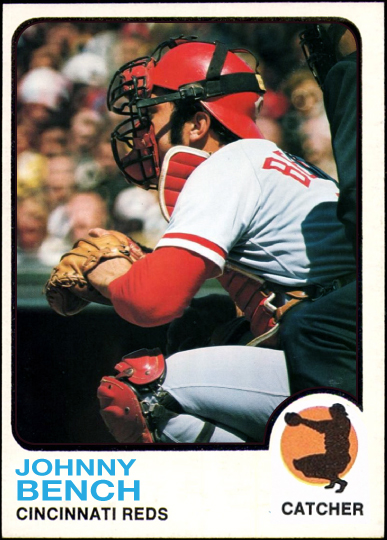
CAN'T HELP MYSELF! ANOTHER 1973 JOHNNY BENCH REDO

Just couldn't help myself!

I know I've created a redone 1973 Johnny Bench card a while back, and even printed it up as part of my old Series 2 pack, but coming across this image made me desperately want to use this for another 1973 edition:

 
Just a beautiful up close and personal in-action shot of the great catcher in his prime with the "Big Red Machine" Cincinnati Reds.
I don’t know about you, but the 1973 Johnny Bench card has always irked me.
I hated the image they used for the reigning National League MVP and uber-star.
Of course, at the time this card would have been pulled from a pack we had Johnny Bench pretty much taking over the baseball world with his second MVP Award in three years, and STILL only 24 years of age, when he slammed a league-leading 40 home runs with 125 runs batted in while taking the Cincinnati Reds back to the World Series.
It was the beginning of the monster we’d get to know as the aforementioned “Big Red Machine”, with other future Hall of Fame members like Tony Perez and Joe Morgan, along with Pete Rose. But it was Bench that was the on-field general leading the way for one of the all-time great runs by an organization.
He wasn’t all offense mind you, as evidenced by his fifth straight Gold Glove. His fifth, and again I have to mention he was only 24!
Incredible talent.
Genuinely a once in a lifetime player.

Monday, August 1, 2022

SPECIAL SPOTLIGHT: "LOST" 1963 FLEER SECOND SERIES: WHITEY FORD

Time to go and throw the spotlight on another of my custom "missing" 1963 Fleer cards, this one of New York Yankees legend Whitey Ford, the "Chairman of the Board":


What needs to be said about quite possibly the greatest Yankee pitcher of all?
Cy Young winner in 1961, winner of 236 games against only 106 losses (a nifty .690 winning percentage), a 2.75 career earned run average, and a member of six world championship clubs.
He led the league in wins three times, winning percentage three times, ERA twice, shutouts twice, and was named to eight all-star teams during his 16-year career.
His 10 World Series wins (along with his eight losses) are Major League high marks to this day, and who knows how much more he could have padded all of his numbers had he not lost two seasons to the military in 1951 and 1952!
When the Hall of Fame came calling he was inducted on his first try, getting named to 284 of 365 ballots in 1974.
Obviously there's so much more to get into with Whitey, but I could end up writing a book here if I did, so I'll leave it up to the Wikipedia's out there to fill anyone in who wants to learn more.
I only wish Ford didn't try to hang on those last couple of years in 1966 and 1967, when he went a combined 4-9, thus eliminating the chance of him being only the second pitcher to this day to retire with 200+ wins and LESS than 100 losses (the other being 19th-century pitcher Bob Caruthers, who finished at 218-99 between 1884-1893).
Oh well, I know I'm nitpicking here…It's the nerd in me I guess.

FOLLOW ME ON TWITTER...

@wthballs
Everything baseball: cards, events, history and more.