Showing posts with label 1972 All Star Set. Show all posts

Friday, February 25, 2022

1972 ALL-STAR SUB-SET: VIDA BLUE

On the blog today, the final "missing" 1972 All-Star card in my thread celebrating perhaps the greatest All-Star game there ever was, the 1971 epic contest held in Detroit, Michigan, and this one is none other than the A.L.'s starting pitcher, Vida Blue:

 
Of course, we all know that Vida Blue absolutely exploded onto the Major League scene in 1971, on his way to capturing both the Cy Young and MVP Awards by season's end.
All he did in this epic season was post a record of 24-8, with a league-leading 1.82 earned run average, striking out 301 batters and tossing eight shutouts.
Oh yeah, he was only 21 years of age!
His WHIP of 0.952 and strikeouts-per-nine-innings of 8.7 also led the league, and he completed 24 of his 39 starts, putting in 312 innings of work for the upstart Oakland A's, who were about to go on the three-peat championship run between 1972 and 1974.
Blue would go on to post 209 career victories in the Majors, having some successful seasons with the San Francisco Giants, even starting the 1978 All-Star game for the National League, while finishing up his 17-year career in 1986.
It’s amazing for me to remember that when Blue started that NL All-Star game in 1978, he wasn’t even 30 years old, yet to me he already seemed to be an aging veteran by then.

Friday, February 11, 2022

1972 ALL-STAR SUB-SET: TONY OLIVA

Up next in my on-going "missing" 1972 All-Star set is the new Hall of Famer Tony Oliva, who was on his way to a third batting crown in 1971 while also being voted as a starter for the classic 1971 game:

 
Oliva would actually not play in the game due to injury, but nevertheless he made his eighth straight All-Star team since bursting onto the baseball world with his Rookie of the Year winning 1964 campaign.
All he did to start his career was win two straight batting titles in 1964 and 1965, also leading the A.L. in hits both years as well as runs and doubles in 1964.
Injuries would nag him throughout his career, however in 1971 he would go on to cop his third batting title, hitting .337 while also leading the league with his .546 slugging percentage.
Of course, all he would do over his 15-year Major League career is have one of the greatest rookie seasons in 1964, easily taking home the top rookie honor in the AL while finishing up fourth in the MVP race, finish second in the MVP race the following season when he helped guide the Twins to their first World Series appearance (though many including myself feel he was robbed of the award, ironically by his own teammate Zoilo Versalles), and lead the league in hits five times, batting three times, doubles four times, while topping .300 seven times.
He was an All-Star eight times while garnering MVP attention eight straight seasons, with three top-5 finishes, and if it wasn’t for injuries we’d be talking about a 3000-hit player with more than three batting titles.
What a great player that gets lost in the shuffle of the glory days of 1960 among legendary names like Aaron, Mantle, Mays and Clemente.

Monday, January 31, 2022

1972 ALL-STAR SUB-SET: FRANK ROBINSON

Moving right along with my "missing" 1972 All-Star sub-set, we come to the second starting All-Star outfielder for the American league in 1971's Midsummer Classic, the great Frank Robinson of the Baltimore Orioles:

 
It was the eleventh All-Star nod for the legend, who would have himself another great year, finishing third in the A.L. MVP race at season's end, hitting .281 with 28 homers and 99 runs batted in.
Robinson is perhaps the “greatest underrated player” in Major League history.
A two-time Most Valuable Player, and the first to do it in both leagues, Robinson also took home a Triple Crown in 1966, was a twelve time All-Star, finished in the Top-4 in MVP voting outside his two wins, and oh yeah, as mentioned earlier was also the first African-American Manager in league history.
When he retired as an active player in 1976, Robinson was in the top-5 in so many offensive categories he was in the company of Babe Ruth, Hank Aaron and Willie Mays.
Yet oddly enough, perhaps because of the era he played in, he would get buried in the “all-time greats” conversation in lieu of the aforementioned players along with guys like Ty Cobb, Roberto Clemente and Ted Williams.
I would say he and Stan Musial are the TWO greatest “underrated” players of all-time, and you could arguably throw in others like Bob Feller for good measure.
Just an all-out legend in so many ways.


Saturday, January 22, 2022

1972 ALL-STAR SUB-SET: CARL YASTRZEMSKI

On the blog today, we move ahead with my on-going "missing" 1972 All-Star sub-set, with starting outfielder Carl Yastrzemski of the Boston Red Sox:

 
"Yaz" made his eighth All-Star team in eleven seasons as a Major League superstar, already the possessor of an MVP Award and five Gold Gloves since bursting onto the Big League scene in 1961.
All he'd do is go on to make another ten All-Star teams before he was through after the 1983 season, along with two more Gold Gloves, eventually taking up his rightful spot in Cooperstown in 1989 on his first year of eligibility.
As someone who grew up in New York City during the second half of his career, it's really easy to forget that Yastrzemski was a Long Island, New York boy before he went on to become a New England legend.
And how could he NOT become a legend, what with 23 years of Major League ball, all with the Red Sox, turning in three batting titles, a Triple Crown in 1967 along with an MVP Award, seven Gold Gloves, 18 all-star nods, and 25 league-leads in primary offensive categories.
By the time he did the retirement tour in 1983, he scored 1816 runs, collected 3419 hits, 646 doubles, 452 homers, 1844 runs batted in along with a .285 batting average.
He was just plain awesome…

Monday, January 10, 2022

1972 ALL-STAR SUB-SET: BROOKS ROBINSON

On the blog today, we move on to the starting third baseman for the American League in that classic 1971 All-Star game, the great Brooks Robinson:

 
Of course Robinson pretty much had the third base position on lock-down for some 15 years in the A.L., and 1971 was no different.
It was the man's 12th straight All-Star nod at third base for the Junior Circuit, and it would also be his 12th straight Gold Glove, on his way to 16 before he was through.
In 1958 he’d play his first full season in the Big Leagues, and it was all cruise control from there, as the great third baseman would go on to grab those 16 Gold Gloves, an MVP Award in 1964, appear in 15 All-Star games, and help guide the Baltimore Orioles to two Championships and four A.L. Pennants.
By the time he hung up that golden glove after the 1977 season, he finished with 2848 hits, 1357 runs batted in, 268 home runs and 1232 runs scored in 2896 games.
Needless to say, by the time Cooperstown came calling, he was voted in on his first try, receiving 92% support in 1983.


Friday, December 31, 2021

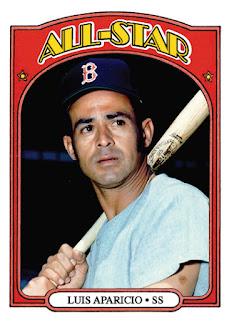
1972 ALL-STAR SUB-SET: LUIS APARICIO

Next up in the "missing" 1972 All-Star sub-set parade is Hall of Fame shortstop Luis Aparicio, the starter for the American League in the 1971 Midsummer Classic:

 
It was the ninth All-Star nod for "Little Louie", who was in the middle of his first season in Boston after coming over from the Chicago White Sox.
Nowadays, we have a guy like Jose Altuve leading the way for players that are not built like mountains, and Aparicio fit that bill between 1956, when he took home the American League Rookie of the Year Award, through the 1973 season, when he retired with over 2600 hits, 1300 runs and more than 500 career stolen bases.
From 1956 through 1964 he led his league in steals every single time, that’s nine straight years, with a high of 57 in 1964 playing for the Baltimore Orioles.
He was both a member of the “Go-Go” Chicago White Sox in 1959, helping them reach the World Series, as well as the surprising 1966 World Champion Orioles, who shocked the world by sweeping the reigning champion Los Angeles Dodgers in the World Series.
The ten-time All-Star also took home nine Gold Glove Awards, teaming up with Nellie Fox to form one of the greatest double-play combos of all time.
He led the AL in fielding percentage eight straight years, between 1959 and 1966, while also leading in assists seven times, putouts four times and double-plays twice.
In 1984 he was selected for Cooperstown by the BBWAA, joining former teammates like Frank & Brooks Robinson & Early Wynn, with others like Nellie Fox and Jim Palmer joining him later on.

Saturday, December 25, 2021

1972 ALL-STAR SUB-SET: ROD CAREW

MERRY CHRISTMAS EVERYONE! 

I hope you are all safe and well on this festive morning.

The next 1971 starting All-Star to celebrate in my on-going 1972 thread is the American League's second baseman, Rod Carew, who made his fifth straight such game in five Major League seasons to start his Hall of Fame career:

 
In addition to the five straight All-Star game nods to start his magnificent career, Carew took home the A.L. Rookie of the Year in 1967 while also winning the 1969 batting title, the first of what would end up being seven titles, including four in a row between 1972 and 1975.
What else really needs to be said about the greatest hitter of his generation?
The man topped .300 15 years in a row, with a high of .388 in 1977 on his way to a Most Valuable Player Award and capturing the public’s attention with his .400 chase late in the season.
A clear-cut Hall of Fame player, he was inducted on his first year of eligibility in 1991 when he garnered 90.5% of the vote, which leaves me with the question: who the hell are the 9.5% who DIDN’T vote for him!!!???
3053 hits, a .328 career average, 353 stolen bases and 15 straight seasons of .300+ batting.Just incredible.

Friday, December 17, 2021

1972 ALL-STAR SUB-SET: BOOG POWELL

On the blog today, we move on to the starting first baseman for the American League in the now classic 1971 All-Star game, fan favorite Boog Powell:

 
Powell made his fourth straight All-Star team in 1971, helping the Baltimore Orioles make it all the way to the World Series before losing to the Pittsburgh Pirates.
He didn't play in the All-Star game however due to injury, so the Detroit Tigers' Norm Cash started in his place.
Nevertheless, the 1970 A.L. MVP was having another solid year, hitting 22 homers along with 92 runs batted in over 128 games and 418 at-bats.
He finished third in the MVP race in 1966 when he clubbed 34 homers to go with 109 RBIs and a .287 batting average, and then finished second in 1969 when he hit 37 homers with a career best 121 RBIs and .304 average.
He would go on to finish his Major League career with 339 home runs, 1187 runs batted in and a .266 average, while being named to four all-star teams, taking home a Most Valuable Player Award in 1970 while with the World Champion Orioles, and two other top-3 MVP finishes in 1966 and 1969, playing for 17 seasons.
Always a fan-favorite in Baltimore, Boog can still be seen around Camden Yards at his "Boog's Barbeque" restaurant.
And who can forget those awesome Miller Lite commercials in the 1980's!? Those were great!

Sunday, December 12, 2021

1972 ALL-STAR SUB-SET: RAY FOSSE

On the blog today, we move on to the American league in celebrating the starters of the classic 1971 All-Star game, with a 1972 "missing" All-Star card for starting catcher Ray Fosse:

 
Now, you'll notice I had to break down and use the image Topps used for his 1971 "Super" card since, believe it or not I just CANNOT find a usable portrait image of him from the period. Incredible that I've been looking for months and nothing.
Regardless, the "Marion Mule" made his second straight All-Star game in 1971, and was a burgeoning star in the league.
By season's end he took home his second straight Gold Glove, while also hitting .276 with 12 homers and 62 runs batted in for the Cleveland Indians.
Contrary to what many believe, the All-Star injury at the hands of Pete Rose did not derail his career, as other injuries along the way in the following years also contributed to his drop in performance.
Nevertheless, by the time Fosse retired after a brief stint with the Milwaukee Brewers in 1979, he finished with a .256 average, with 758 hits over 2957 at-bats, driving in 324 runs while scoring 299 himself over 924 Big League games.
On another note, you really have to wonder how good those Cleveland Indians could have been by the late-70’s had they NOT traded away players like Graig Nettles, Dick Tidrow, Chris Chambliss and Fosse.
Rest in Peace Ray Fosse...

Saturday, December 4, 2021

1972 ALL-STAR SUB-SET: DOCK ELLIS

Really fun card to add to the blog AND my on-going 1972 All-Star "missing" sub-set today, a card for the National League's starting pitcher in the 1971 Midsummer Classic, Pittsburgh Pirates pitcher Dock Ellis:

 
Ellis was on his way to his best year as a Big League pitcher in 1971, and with that was given the honor of starting what turned out to be one of the historic All-Star game in baseball history, featuring somewhat of a transition of the "old" classic baseball of the 1950's and 1960's with stars like Willie Mays, Hank Aaron and Roberto Clemente, while also showcasing young up and coming superstars of the new age like Johnny Bench, Reggie Jackson and Rod Carew.
By the time 1971 ended Ellis finished with a very nice 19-9 record for the eventual World Champions, sporting an earned run average of 3.06 over 31 starts, with 11 complete games and two shutouts, tossing a career-best 226.2 innings.
Those numbers would get him a fourth place finish in the Cy Young Award race in November, with Chicago Cubs great Fergie Jenkins winning it based on his league-leading 24 wins.
Of course, we would be terribly negligent here without also mentioning that Ellis was the pitcher who served up the classic bomb hit by Reggie Jackson in the All-Star game that almost cleared the ballpark, a moment that marked somewhat of the arrival of the man who would go on to be nicknamed "Mr. October" and become a household name across the country by decade's end.
Nevertheless, Ellis would go on to pitch 12 years in the Majors, finishing up after the 1979 season, posting a final record of 138-119 over 345 games, 317 of them as a starter, tossing 14 shutouts and striking out 1136.

Saturday, November 27, 2021

1972 ALL-STAR SUB-SET: WILLIE STARGELL

Up next in the cavalcade of 1971 starting All-Stars given their due in the 1972 set with "missing" All-Star cards is Hall of Famer Willie Stargell of the Pittsburgh Pirates, the third outfielder for the National League joining,up with Mays and Aaron:

 
Though already a three-time All-Star by the time 1971 rolled around, Stargell really had his breakout season in 1971, eventually leading the N.L. with 48 homers while also driving in a career-best 125 runs, scoring 104 himself.
Those monster numbers would get him a second place finish in the MVP race, something he'd also do two years later.
He'd have to wait until 1979 when at the age of 39 he'd finally get his MVP Award, leading the Pirates to their World Series win over the Baltimore Orioles with their "We are family" team, with "Pops" taking the team on his shoulders.
Luckily, I got to see him towards the end of his career in the late-70's/early-80s before he retired after the 1982 season.
His final number? Hall of Fame worthy as he'd finish with 475 home runs, 1540 RBIs, a surprisingly high .282 batting average and 2232 hits over 2360 games and 7927 at-bats.
Think about those numbers in UNDER 8000 at-bats!
Of course when eligible for the Hall of Fame, he was in, with 82.4% of the vote in 1988.
So sad that he would pass away at only 61 years of age in 2001.

Saturday, November 20, 2021

1972 ALL-STAR SUB-SET: WILLIE MAYS

Moving along in my on-going 1972 All-Star sub-set thread today, we have the great, if not greatest, Willie Mays as the next outfielder who started for the National League in the classic 1971 Midsummer Classic:

 
Though Mays was winding down his incredible baseball career by the time the 1971 season rolled around, he was still producing, finishing the season with 18 home runs and 61 runs batted in for the San Francisco Giants, leading the league with his 112 base on balls and .425 on-base-percentage.
Anyway, not much to get into about arguably the best all-around player in baseball history. 3000+ hits, 660 homers, 1900+ R.B.I.'s., 1951 Rookie of the Year and N.L. M.V.P. in 1954 and 1965. But he was much more than just stats. He was the "Say Hey Kid".
By the time the 1970's hit, he was a walking legend of the sport, and being enshrined in the Baseball Hall of Fame in 1979 was the cherry on top of it all.

Saturday, November 13, 2021

1972 ALL-STAR SUB-SET: HANK AARON

Today on the blog we move on to the National League's All-Star outfielders for the classic 1971 Midsummer Classic, featuring three absolute STUDs, beginning with the great Hank Aaron:

 
Aaron made his 21st, yes TWENTY-FIRST, straight All-Star game in 1971, counting the four seasons where baseball held two such games in the early 60's.
The man put in yet another year we were spoiled with from "Hammerin' Hank", going on to hit a career-best 47 home runs to go along with 95 runs scored, 118 RBIs, a .327 batting average and a league-leading .669 slugging percentage.
The 47 homers made Aaron one of only two men to hit 40 homers in a season in three different decades, with only another HOFer, Harmon Killebrew achieving the feat.
The man was simply out of this world...
Let his numbers do all the talking: 2174 runs scored, 3771 hits, 624 doubles, 98 triples, 755 home runs, 2297 runs batted in, a .305 batting average no less than 21 all-star selections!
Just tremendous!
He also had eight top-5 finishes for MVP, including taking home the award in 1957, as well as three Gold Gloves won consecutively between 1958-1960.
It's incredible to look at his 15 years of topping 100 or more runs scored, 11 seasons of 100 or more runs batted in, five more seasons of 90+ RBI's, and TWENTY STRAIGHT years of 20 or more home runs.

Rest in Peace to one of the absolute greats of the game, Mr. Henry Aaron...

Friday, November 5, 2021

1972 ALL-STAR SUB-SET: JOE TORRE

Next up in my on-going 1972 All-Star sub-set special is the starting third baseman for the National League in the classic 1971 Midsummer Classic is Joe Torre, Hall of Fame manager who also put in a borderline Hall of Fame playing career:

 
Of course, we all know that Torre had the season of his career in 1971, leading the N.L. in both batting average, hitting at a .363 clip, while also pacing the league with his 230 hits and 137 runs batted in.
The man was just converting over to full time third base work after coming up as a catcher with the Milwaukee Braves in 1960 at the age of 19, before shifting to first base later on when the team moved to Atlanta in 1968.
The Brooklyn-native really did put together a career that gives him a second look as a Hall of Fame player.
It’s easy to forget how he came up as a catcher and had some monster years for the Milwaukee/Atlanta Braves between 1961 and 1968 before being traded to St. Louis for Hall of Famer Orlando Cepeda right before the 1969 season opened.
Five times he would top 100 runs batted in, while topping 200 hits twice, 20 home runs six times and a .300+ batting average five times on his way to career numbers of 1185 RBIs, 2342 hits, 252 homers and a very nice .297 MLB average.
He finished second in the NL Rookie of the Year race in 1961 behind future Hall of Famer Billy Williams, and was named to nine all-star teams over the course of his career.
Of course, once he moved on to managing, particularly when he took over duties with the New York Yankees in 1996, his path to Cooperstown was laid out in front of him, leading the Bronx Bombers to World Series wins four times, including three in a row between 1998-2000, with the ‘98 team considered one of the best teams of all-time, winning 114 regular season games along with 11 more, steam-rolling through the San Diego Padres for a world championship.
Over 29 seasons as a manager, Torre finished with 2326 wins along with a nifty .538 winning percentage. Looking at his Yankee tenure, he finished an incredible 1173 and 767, good for a sparkling .605 percentage, averaging just under 100 wins a season!
So of course, in 2014 he made it into the Hall, being selected by the Veteran’s Committee after a combined 47 years in Major League ball as a player or manager.

Friday, October 29, 2021

1972 ALL-STAR SUB-SET: BUDDY HARRELSON

Next up in my on-going 1972 All-Star sub-set is the starting shortstop for the National League in the classic 1971 Midsummer classic, New York Met Bud Harrelson:

 
Harrelson made his second straight All-Star team in 1971, arguably his two best seasons in the Big Leagues, in which he got MVP consideration at the end of the year, as well as winning his only Gold Glove.
The typical "light-hitting/good fielding" middle infielder of the time, he gave the Mets a solid glove man up the middle between 1965 and 1977 before taking his leather to the Philadelphia Phillies in 1978.
By the time he retired after the 1980 season after one year with the Texas Rangers, he finished with a career .236 average, with 1120 hits in 4744 at-bats, with 539 runs scored, 127 stolen bases and 267 RBIs over 1533 games.

Saturday, October 23, 2021

1972 ALL-STAR SUB-SET: GLENN BECKERT

Next up in my new thread celebrating the greatest All-Star game of the 1970's, if not ever, is my 1972 All-Star card for the National League's starting second baseman for the 1971 Midsummer Classic, Glenn Beckert of the Chicago Cubs:

 
Though only in the Big Leagues for eleven seasons, Beckert had a very nice career, getting four All-Star nods, a Gold Glove, and giving the Cubs a solid second baseman alongside guys like Ron Santo, Billy Williams and Ernie Banks.
The 1971 season was perhaps the best in Beckert's career, as he would go on to hit a career-high .342 while collecting 181 hits, with 80 runs scored and 42 runs batted in.
Between 1966 and 1971 he never hit below .280, and in 1968 he led the National league with 98 runs scored during the "year of the pitcher."
By the time he retired after the 1975 season, he finished with a very nice .283 batting average, with 1473 hits over 5208 at-bats and 1320 games.

Saturday, October 16, 2021

1972 ALL-STAR SUB-SET: WILLIE McCOVEY

On the blog today, we move on to the National League's starting first baseman in the classic 1971 All-Star game, "Stretch" Willie McCovey:

 
Celebrating what is now considered one of the historic moments in the game's evolution, the 1971 Midsummer Classic was a turning point where the "old" eased into the "new". A passing of the torch in a sense of the country's cultural change, with old stars such as Aaron, Mays, et. al. handing it all over to the "new", like Reggie Jackson, Vida Blue and Johnny Bench.
As for McCovey, he was one of the "tweens" in this scenario, as he was already a 12 year veteran of the game, but somehow was a new breed of player that brought a refreshing change to the Major League landscape.
McCovey was three years removed from his MVP season of 1969 when this card would have been out, but still a feared hitter terrorizing N.L. pitching.
It was his fourth straight All-Star game, and and sixth overall, and he'd even get some MVP support at season's end, with a 15th place finish in the voting.
By the time he retired in 1980, he crushed 521 home runs, collected over 2000 hits, drove in over 1500, and left his mark as one of the most feared sluggers of his generation.
In 1986, his first year of eligibility, he was voted into the Hall of Fame with 81.4% of the ballots cast.
Man, what a threesome McCovey, Willie Mays and Orlando Cepeda made back in the 1960's for San Francisco, huh?
Just incredible.

Saturday, October 9, 2021

1972 ALL-STAR SUB-SET: JOHNNY BENCH

Today we start a fun new thread, celebrating one of the greatest All-Star games, the 1971 Midsummer Classic, with a special 1972 All-Star subset, beginning with the National League catcher, Johnny Bench of course:

 
It's a shame Topps didn't include All-Star cards in their classic 1972 set, whether it be on-base All-Star banner or a separate sub-set (I prefer on-base-card), being that the 1971 All-Star game is still arguably the greatest ever played.
With the combination of aging all-time greats like Mays, Aaron, Clemente and up-and-comers like Bench, Jackson, Blue, combined with the era of American society transitioning to a more "modern" era, it was incredibly significant in more ways than just "sports".
So we begin with Bench, who by then was already entrenched as the premier catcher in baseball, and an All-Star constant through the rest of the decade.
I'll be creating and posting the starters of that game over the next few months, starting with the National League, before perhaps creating cards for the non-starters, who happen to be some big-time names.
I also plan on having this as a special printed set in the future, some time in 2022!
Enjoy!


FOLLOW ME ON TWITTER...

@wthballs
Everything baseball: cards, events, history and more.