Showing posts with label 1965. Show all posts

Saturday, April 18, 2026

CAREER-CAPPER: 1965 PETE RUNNELS

Up on the blog today, let's delve into the 1960s and give two-time batting champ Pete Runnels a 1965 "Career-Capper" shall we?
Here you go:


Runnels put in what turned out to be the last Major League action of his career in 1964, as a member of the Houston Colt .45s, or Astros as they were making that transition at that time.
Just two years removed from his second batting title in 1962, he hit .196 over 22 games for Houston, with 10 hits over 51 at-bats with three RBIs.
Runnels took home the American League batting title in 1960 and 1962 as a member of the Boston Red Sox, hitting .320 and .326 respectively, topping the .300 mark all of his five years with Boston.
His first seven years in the Big Leagues were with the Washington Senators between 1951 and 1957, where he average about .280 while playing both the infield and outfield, even getting some MVP votes in both 1952 and 1956.
Overall, by the time he retired, he finished with a .291 batting average, with 1854 hits in 6373 at-bats over 1799 games, getting named to five All-Star teams along the way.
Not too shabby a career!


Saturday, February 28, 2026

MISSING IN ACTION: 1965 DON MOSSI

As promised recently on Twitter, today on the blog we have a "missing" 1965 card for pitcher Don Mossi, who suited up for the Chicago White Sox in 1964, having a decent year, and for some reason getting ignored by Topps the following year:


Mossi appeared in 34 games for the White Sox, all in relief, going 3-1 with a nice 2.93 ERA over 40 innings, with seven saves and 36 strikeouts.
The following season turned out to be his last as a Big Leaguer, suiting up for the Kansas City Athletics, going 5-8 over 51 games at the age of 36, pitching to a 3.74 ERA in 55.1 innings, once again posting seven saves.
Mossi had some really good years in the Majors over his 12 seasons under the Sun, with his two finest arguably 1959 and 1961 with the Detroit Tigers when he posted records of 17-9 and 15-7 respectively with ERAs of 3.36 and 2.96 as a starter.
By the time he did retire, he finished with a record of 101-80 over 460 appearances, with a 3.43 ERA and 50 saves between 1954 and 1965.

Wednesday, July 2, 2025

1960s "IN-ACTION": 1965 WILLIE STARGELL

Up on the blog today, we have my 1965 "In-Action" card for Pittsburgh Pirates legend Willie Stargell, from my recent "Series 3" set released a few months ago:


Over 21 seasons, Stargell would lead the Pittsburgh Pirates to two world championships, take home an MVP Award in 1979 (shared with the Cardinals Keith Hernandez), and get named to seven All-Star teams.
He would also have a great three-year run between 1971 and 1973 that saw him finish second, third and second respectively in MVP voting, winning two home run titles, an RBI title and even lead the league with 43 doubles (1973).
Luckily, I got to see him towards the end of his career in the late-70's/early-80s before he retired after the 1982 season.
His final numbers? Hall of Fame worthy as he'd finish with 475 home runs, 1540 RBIs, a surprisingly high .282 batting average and 2232 hits over 2360 games and 7927 at-bats.
Think about those numbers in UNDER 8000 at-bats!
Of course when eligible for the Hall of Fame, he was in, with 82.4% of the vote in 1988.
So sad that he would pass away at only 61 years of age in 2001.
One of baseball's beloved players, especially among his fan-base, he left such a lasting legacy that resonates to this day.


Tuesday, September 3, 2024

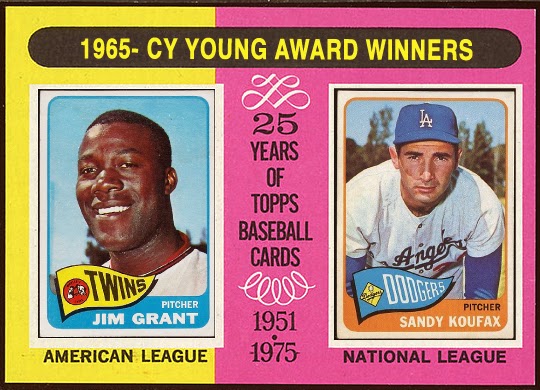
REVISITING A TEN-YEAR-OLD POST: 1975 CY YOUNG SUB-SET: 1965 WINNERS

Fun card/post to revisit today: from April of 2014, my 1975 Cy Young winners for 1965 sub-set, imagining if Topps also created a Cy Young set to go along with their wildly popular MVP set in that beautiful, colorful set from just under 50 years ago:


Here's the original write-up for the post from eons ago:
"We're up to 1965 on my Cy Young sub-set for the 1975 set, and once again we are visited by Mr. Sandy Koufax, who would have won his third such award in a row had there been voting for both leagues back then.
Koufax is joined by Minnesota Twins pitcher Jim "Mudcat" Grant, who was selected by the people at SABR as the probable winner in the American League.
For Koufax it was business as usual, as he posted another monster season on the hill, going 26-8 with a 2.04 earned run average and a then Major League record 382 strikeouts.
He also threw eight shutouts among his league-leading 27 complete games, and threw in two saves for good measure.
He also finished second behind Willie Mays for the National League Most Valuable Player award, receiving six first-place votes to Mays' nine.
After 30 some-odd years of looking at his stats I'm still blown away by them! 
What a freaking run of domination.
Over in the American League, Jim Grant came out of nowhere to post what is easily his best year as a Major League pitcher, going 21-7 with a 3.30 E.R.A., a league-leading six shutouts and 142 strikeouts.
Up until the 1965 season, Grant's top win total his previous seven seasons in the bigs was 15 in 1961 for the Cleveland Indians.
For HIS efforts in 1965 he finished sixth in M.V.P. voting, behind teammate Zoilo Versalles in Minnesota's improbable run to the World Series, where they lost to, (who else?), Sandy Koufax and his Los Angeles Dodgers.
Next up, 1966, where the Twins and Dodgers are represented once again, this time with Koufax being joined by Twins' pitcher Jim Kaat."


Sunday, January 7, 2024

1960'S IN-ACTION SPECIAL: 1965 BOB GIBSON

Good day everyone!

Excited to introduce you all to a new thread, and new custom set today, that my "1960's In-Action" series, which will have special in-action cards throughout the Topps sets of the 1960's, imagining if Topps began using action shots before their 1971 set.
So today we will start it off with a 1965 In-Action card of the great Bob Gibson:


This will be a multi-release series of cards, with 10 cards per series (one for each year of the 1960's), along with a random "bonus" card of a non-Topps, or non-1960s card.
I have been wanting to do this for quite some time now, and finally had the chance to release the first series this month.
Today's card shows Gibson in classic form, coming off a wonderful 1964 season that saw him lead the St. Louis Cardinals to a championship, defeating the New York Yankees in the World Series, with "Gibby" going 2-1 in his three starts, with two complete games and 31 strikeouts over 27 innings.
Bob Gibson has always been one of my favorite all-time players and competitors. Besides the obvious things to love about the guy as far as his stats go, it was the over-the-top drive and no-nonsense play that had me hooked.
Ever hear Tim McCarver tell the story of the first time he saw Gibson after Tim was traded to the Phillies in October of 1969? If not here goes:
Before a game between the Cardinals and the Phillies in 1970, both teams were on the field loosening up and getting ready. Tim, who was a teammate of Gibson for about ten years before being traded, figured he'd go say hello to him. Not only were they teammates for so long, but they came up in the Cardinals system together in the late-50's.
Well as Tim says it, he went up to Gibson near the batter's box, stuck out his hand and went to say "hi", and knew immediately he was done for. Gibson just stared him down and walked away.
First time McCarver was up at the plate, Gibson delivered his first pitch and brushed him back.
Message delivered: they weren't teammates anymore, and while ON the field, they were enemies.
How can you NOT love that!?
The man was a force on the mound, and of course his 1968 season is the stuff of legend. I STILL wonder how on earth he managed to have 9 losses with a season E.R.A. of 1.12!!! Just incredible.
He'd play through the 1975 season, eventually settling for 251 wins as a Big League ace, along with 3117 strikeouts (only the second pitcher ever to reach that mark at the time), 56 shutouts and a brilliant 2.91 E.R.A. Needless to say, the Hall of Fame was sure to call in 1981 and an obvious choice for induction was granted.

Friday, May 26, 2023

1960'S "DEDICATED ROOKIES": 1965 TONY PEREZ

On the blog today, we spotlight my 1965 "Dedicated Rookie" for Hall of Famer Tony Perez, the RBI-machine, from my special set released a few years ago:


Perez truly was an overlooked star on a team that would also have guys like Pete Rose, Johnny Bench and Joe Morgan, just to name a few, and it’s just plain criminal considering he logged 10 seasons in a row over 90+ runs batted in, with six of them over 100 as stated earlier.
With a batting average hovering around .280, he was a solid and steady force at the plate and out in the field for a team that would become legendary, on their way to two straight championships in 1975 and 1976.
He would play for 23 seasons in the Major Leagues, and end up with 379 homers, 1652 RBI’s, 2732 hits and a very nice .279 average before he left the game at the age of 44.
The “Big Dog”, Sparky Anderson always stated that what killed the “Big Red Machine” from dominating longer was trading away their slugging first baseman in December of 1976 to the Montreal Expos for Woodie Fryman and Dale Murray, a trade that still baffles me.
Nevertheless, after nine tries, he finally made it into the Hall of Fame in 2000, and rightly so. Hopefully Pete Rose can also join his former teammates someday as well.

Monday, March 13, 2023

1960'S DEDICATED ROOKIE: 1965 STEVE CARLTON

On the blog today, we spotlight my 1965 "dedicated rookie" for all-time great Steve Carlton, from my 1960's Dedicated Rookie" set released in 2020:


Carlton made his major League debut during the 1965 season, appearing in 15 games, with two of those starts, not factoring in a decision while pitching to a 2.52 earned run average as a 20-year-old.
In 1966 it would be more of the same, as he'd appear in only nine games, going 3-3 with a 3.12 ERA in 52 innings of work, striking out 25 while walking 18, also tossing the first shutout of his young Big League tenure.
1967 would see him begin his next level of play, as he'd go 14-9 with a 2.98 ERA over 30 appearances and 193 innings, with two shutouts and 168 strikeouts, helping the St. Louis Cardinals win it all, their second championship in three years.
For Carlton, all he did the rest of the way was top 300 wins, 4000 strikeouts, 50 shutouts and 700 starts in his 24 year career!
The first guy to take home four Cy Young Awards, he led his league in wins four times, strikeouts five times, E.R.A. once and was named to ten all-star teams.
Needless to say, by the time he was eligible for the Hall of Fame, he was in on his first try, getting named to 436 of 456 ballots.
Sure we already had "Lefty" Grove, and "Lefty" Gomez, but Carlton was more than worthy of the same nickname for all of his accomplishments.


Monday, March 6, 2023

1965 MISSING WORLD SERIES SUB-SET IN 1966 SET: GAME 1

Today on the blog, we begin a 1960's "missing" thread, this one the missing cards from the 1966 set covering the 1965 World Series:


For some reason in 1966, Topps decided to scrap the popular World Series sub-set from their set, which a few of us were discussing on Twitter a few months back, so I thought it's be fun to whip-up a quick set highlighting each game, seven in total since the Series went the full seven games.
The Los Angeles Dodgers faced the Minnesota Twins in the World Series, a match-up that had the Dodgers who had their aces Sandy Koufax and Don Drysdale battling the heavy-hitting Twins, with players like Harmon Killebrew and young stud Tony Oliva.
In Game 1 at Metropolitan Stadium in Minneapolis, Drysdale would open the series up against Jim "Mudcat" Grant, and by the time the game was over the Twins surprised everyone with an 8-4 win, knocking Drysdale out of the game by the third inning.
Grant would toss a complete game, allowing only two runs on ten hits, while Drysdale was roughed up, allowing seven runs in 2.2 innings, three of those runs earned.
The hitting stars of the Twins that day had Don Mincher and 1965 A.L. MVP Zoilo Versalles with both hitting homers, Versalles also driving in four runs.
The lone stand-out batter for L.A. would be Ron Fairly, who hit a solo-homer in the 2nd inning, while Maury Wills would go 2-for-5 at the plate.
Next week, a Game 2 highlight card!

Thursday, February 16, 2023

1960'S DEDICATED ROOKIE: 1965 JOE MORGAN

Today's blog post has a spotlight on my 1965 "dedicated rookie" for Hall of Fame second baseman Joe Morgan, from my special set produced a couple of years ago:


For Mr. Morgan, the man was just beginning a run that would send him straight to the Hall of Fame, while helping eventually build a juggernaut of a team forever known as the "Big Red Machine" when he was dealt to to Cincinnati before the 1972 season.
Those Reds teams would win two straight World Series in 1975 and 1976, and field teams with the likes of Pete Rose, Johnny Bench, George Foster and Ken Griffey Sr.
By the time he retired after the 1984 season at the age of 40, he finished with two MVP Awards, 10 All-Star nods, five Gold Gloves, 2517 hits, 1650 runs scored, 268 homers and a cool 689 stolen bases with 1865 walks.
One of the all-timers right there at second base!


Thursday, February 9, 2023

1960'S DEDICATED ROOKIE: 1965 JIM "CATFISH" HUNTER

On the blog today, we spotlight another card from my 1960's Dedicated Rookie set released a couple of years ago, this time my 1965 card for Hall of Famer Jim "Catfish" Hunter:


Hunter was a 19-year-old who hadn't yet pitched in a Big League game when this card would have come out, who would go on to finish 8-8 over 32 games with two shutouts and a 4.26 earned run average over 133 innings.
Over his 15-year career, which wrapped up in 1979 due to arm troubles, Hunter racked up 224 wins, a 3.26 earned run average, 42 shutouts and 2012 strikeouts.
He took home the Cy Young Award in 1974 in his last season with the A's, came in second for the award the following year in his first year as a landmark Free-Agent with the Yankees, and threw a perfect game back in 1968 at the young age of 22.
A big-game pitcher, Hunter was a member of no less than five World Champion teams: 1972-74 Oakland A's, and the "Bronx Zoo" Yankee teams of 1977-78.
Did you know that Hunter is the last pitcher in the Major Leagues to complete 30 or more games in a season? 
In 1975 he completed 30 of his 39 starts, on his way to a 23-14 record with seven shutouts and a 2.58 E.R.A.
Between 1971 and 1975 he won 20 or more games each year, a great five year run which saw him win 111 games.
As a matter of fact, Hunter was the first pitcher since the all-time great Walter Johnson to win 200 games before the age of 31! And the only other guys at that time to also do it? Christy Mathewson and Cy Young. Incredible.
Sadly arm troubles and diabetes started to affect his career, forcing him to retire in 1979 at the age of only 33.
The final feather in his baseball cap would be a Hall of Fame induction in 1987 along with Chicago Cubs great Billy Williams, giving him a solid place in baseball history, if he didn't have one already...


Friday, February 3, 2023

1960'S CAREER-CAPPERS (FIRST TIME AROUND FOR THIS PLAYER): 1965 MINNIE MINOSO

Up on the blog today, from my 1960's "Career-cappers" set released a couple of years ago, my 1965 card for the great Minnie Minoso, new member of the Hall of Fame:


As we all know, Minoso would actually come back as a publicity stunt in 1976 and again in 1980 while a coach with the Chicago White Sox, but his "first" retirement came after 30 games with the White Sox in 1964 at the age of 40.
Minoso, aka the “Cuban Comet”, is finally a Hall of Famer, and I always felt the stunts in 1976 and 1980 may have even hurt his chances of getting into Cooperstown.
From 1951 to 1961 he had a wonderful Major League career, leading the league in stolen bases three times, triples three times, and hits and doubles once each, while also driving in over 100 runs four times and topping 20 homers four times.
Eight times in that span he would top a .300 batting average, and in 1951 many consider him the true American League Rookie of the Year when he hit .326 split between the Cleveland Indians and Chicago White Sox, while topping the league in triples with 14 and stolen bases with 31.
Along the way he was named to seven All-Star games, winning three Gold Gloves as well, funny enough finishing fourth in the A.L. MVP race four times.
Of course, 12 years after his last playing days, in 1976, he ended up going 1-for-8 at the plate as a 50 year-old, then coming back in 1980 at the age of 54 and going hitless in two at-bats.
Nevertheless, Minoso finished his career with a .298 average, with 1963 hits over 6579 at-bats, along with 186 homers and 205 stolen bases while also topping 1000 runs scored and RBIs, 1136 & 1023 respectively.

Friday, January 27, 2023

1960'S CAREER-CAPPERS: 1965 DUKE SNIDER

Up on the blog today, we visit another of my previous custom sets, and spotlight a card, this time my 1965 "career-capper" for the great Duke Snider:


Snider played 91 games for San Francisco in 1964, capping off a great 18-year Major League career that saw him make eight All-Star teams while post six seasons where he finished in the top-10 for N.L. MVP.
Snider was an absolute beast of a hitter through the 1950's with the Dodgers, driving in over 100 runs six times, 30+ homers six times including five straight seasons of 40 or more, five years of scoring over 100 runs and seven seasons of .300 hitting or better.
By the time he retired after the 1964 season he hit 407 homers, with 1333 RBIs and a .295 average, with 2116 hits and 1259 runs scored over 18 seasons as a player.
It must have been painful for Dodger-faithful to see their beloved "Duke of Flatbush" suit up for the Giants, something Giants fans had to deal with about 10 years later with their beloved ace Juan Marichal.
Go figure.

Tuesday, May 17, 2022

CUSTOM SPOTLIGHT: 1965 TONY HORTON

The next card from my "Whole Nine" set released last year to get the spotlight here on the blog is my "missing" 1965 card for enigmatic slugger Tony Horton:


Horton originally came up with the Boston Red Sox in 1964 as a 19-year old, appearing in 36 games, hitting .222 with a homer and eight runs batted in.
After a couple of more sporadic seasons bouncing between the Majors and Minors with Boston, Horton was traded to the Cleveland Indians in 1967 for pitcher Gary Bell, and finally got some full-time work with the parent club.
After a couple of decent years he really came into his own in 1969, hitting .278 with 27 homers and 93 runs batted in on 174 hits in 625 at-bats.
1970 started out well for the young slugger, as he had a three-homer game against the Yankees as well as hitting for the cycle on July 2nd against the Orioles, but after a prolonged slump and constant booing from the fans, the emotional toll finally came to a head for Horton as he took himself out of a game on August 28th against the Angels.
It was the second game of a double-header, and he voluntarily left the game after the fifth inning.
Sadly, later that evening he attempted suicide, but luckily survived and eventually got treatment for his problems.
But as for his baseball career, he'd never appear in another Major League game again.
His former manager, Alvin Dark, stated that in his long baseball career, the Horton situation was the "most sorrowful incident I was ever involved in, in my baseball career."
Tony Horton was only 25 years old when he left the game, after only 636 games and seven years, and has always been a stark reminder of the pressures professional athletes have day to day that fans can easily overlook as they're entertained on an almost nightly basis for six-motnhs out of every year.

Sunday, January 22, 2017

TURN BACK THE CLOCK: SATCHEL PAIGE PITCHES AT AGE 59!

Today we celebrate the “ageless one”, legendary Negro Leagues pitcher and future Hall of Fame member Satchel Paige and his unlikely pitching performance in 1965 at the age of 59 for the Kansas City Athletics:


Signed by Athletics team owner Charlie Finley for one game, Paige came in to pitch on September 25th against the Boston Red Sox, starting and eventually pitching three innings and surrendering a single hit while striking out one batter in his stint, thus closing the books on his sadly abbreviated Major League career, which BEGAN back in 1948 with the Cleveland Indians when Paige was already 41 years of age.
Because of baseball’s segregation, Paige made himself a legend beyond legends in the Negro Leagues, becoming one of the all-time greats on the mound, and off of it as well with his personality and pitching talents.
As a Major League pitcher spanning six seasons between 1948 and 1965 Paige would put together a 28-31 record with a nice 3.29 earned run average in 179 games, 26 of them starts, all this while in his 40’s!
Who knows what this icon could have done pitching in the Major Leagues, though he was STILL rightly honored with a place in Cooperstown, being voted into the Baseball Hall of Fame in 1971 and becoming the first true Negro Leagues star player to be so recognized.

Saturday, January 14, 2017

TURN BACK THE CLOCK 1965- WILLIE MAYS SMASHES HIS 500TH CAREER HOME RUN

Here’s a “Turn Back the Clock” card for the 1975 set celebrating the 10th anniversary of  Willie Mays 500th career home run, which he hit on September 13th, 1965 off of  Houston Astros starter Don Nottebart:


The blast was the 47th of the season for Mays, on his way to a career-high 52 for the season leading to his second career Most Valuable Player Award, the first which came eleven years earlier while the Giants were still in New York.
He would go on to slam another 160 homers before he was through, ending up with 660 to cement his legacy as one of the greatest sluggers, and most importantly players in baseball history.

Sunday, January 1, 2017

TURN BACK THE CLOCK- SANDY KOUFAX THROWS PERFECT GAME

Today we have a “Turn Back The Clock” card to celebrate Sandy Koufax and his Perfect Game of September 9th, 1965, against the Chicago Cubs in what many consider the greatest game ever pitched by BOTH pitchers:


Having been winless for just about three weeks at the time, Koufax came in to start against the Cubs and their recent call-up Bob Hendley (the 1st 1966 card I ever got by the way).
The game would turn out to be historical for more than just Koufax and his fourth no-hitter.
Turns out for seven innings Bob Hendley would match the great lefty frame for frame, not allowing a hit to the eventual World Champions until Lou Johnson hit a bloop behind the second baseman to break up HIS no-hitter.
Koufax, however, would keep going, not allowing a Cubs base-runner, let alone a Cubs hit, striking out 14 batters in setting a new Major League record with FOUR no-hitters, one more than Indians legend Bob Feller.
Sadly for Hendley, the lone hit he would give up didn’t even factor into the one unearned run he would give up in the tough loss.
In the bottom of the fifth inning the Dodgers would score after a walk to Lou Johnson, followed by a sacrifice by Ron Fairly, a steal of third by Johnson which led to a error by catcher Chris Krug allowing Johnson to score.
The game had a total of ONE hit and TWO base-runners, and would be the last time the Cubs were no-hit until Cole Hamels pulled the trick in 2015.
Koufax would hold that record of four no-hitters until a guy like Nolan Ryan came along and threw his fifth in 1981, followed by two more some ten years later giving him a total of seven, which will probably never be matched.

Wednesday, December 21, 2016

TURN BACK THE CLOCK: THE ASTRODOME OFFICIALLY OPENS IT'S DOORS

Let’s go and celebrate what could be considered the beginning of the “modern” stadiums across baseball, the grand opening of that “8th Wonder” in Houston, the Astrodome:


On April 12th, 1965 the Astros played their first official game against the Philadelphia Phillies after an exhibition game against the Yankees three days earlier.
Chris Short of Philadelphia made sure the Houston fans, all 42,652 of the, went home unhappy as he pitched a four-hit shutout, striking out 11 while getting help from (who else) Dick Allen (then “Richie”), who slammed a two-run shot in the third inning off of Astros starter Bob Bruce, who would go seven innings before giving way to Hal Woodeshick who threw the final two frames.
The stadium made it possible for the Astros to play during the scorching Houston Summer with it’s air conditioning and later on it’s “Astroturf” after initial attempts to utilize natural grass failed.
For me, the Stadium along with other “Modern” atrocities like the cookie-cutter Riverfront , Veteran’s and Three Rivers Stadiums with their knee-killing artificial turf made for some unnatural atmosphere’s for a game that was supposed to be all about the great outdoors.
However the times they were a’changin’ and it wouldn’t be until the 1990’s when Major League Baseball returned to their senses and went back to more traditional styles for new ballparks.
But like it or not, the Astrodome was BIG news when it opened as was a marvel of modern technology not only for professional sports but for modern engineering.

Saturday, September 27, 2014

LONG TIME NO SEE: 1970 SKIP LOCKWOOD (#499)

Sorry for the late post! Had to trek out to upstate NY for the newest member of the family, a beautiful Australian Cattle dog/Collie mix pup, no name as of yet! A nice pal for our Anatolian Shepherd, "Bossy".
Anyway, onto today's topic...
When I recently designed my "Super Veterans" card for Jim "Catfish" Hunter, I took a closer look at his 1965 rookie card and realized that Skip Lockwood, who I grew up knowing as a pitcher for the N.Y. Mets, actually came up as an infielder with the Kansas City A's.
Take a look:


On top of that, after his initial 1965 rookie card appearance, the next time he was on a baseball card was in the 1970 Topps set (#499), now as a pitcher for the Seattle Pilots: a five year gap.
Take a look at his follow-up card from the 1970 set:


I never realized Lockwood's road to the big league mound, and that he was first a shortstop for the A's in 1965, without much success in 42 games: four hits (all singles) in 33 at-bats, a .121 batting average.
Stranger still, aside for those 42 games with the parent club, Lockwood didn't play any Minor League ball that year (?). Weird.
Over the next three years, he was mired in the Minors, now converted to a pitcher, and eventually found himself as a member of the new Seattle Pilots come 1969. Getting into six games, good for 23 innings of work and a 0-1 record.
(It also raises the obvious question as to why Topps gave him a card in the 1970 set with such scant playing time!)
In 1970, Lockwood would become a full-time Major League pitcher, and go on to have 11 decent years pitching for the Brewers, Angels, Mets and Red Sox.
He'd really find his niche as a reliever for the New York Mets between 1975 and 1979, having his best year in 1976, going 10-7 with 19 saves and a nifty 2.67 earned run average over 56 games and 94.1 innings.
The following year he posted a career high 20 saves for the Mets, with a 7-13 record and 3.57 E.R.A., in 57 games and 104 innings.
After a year pitching for Boston in 1980, Lockwood's big league days were over, retiring with a 57-97 career record, with a 3.55 E.R.A., five shutouts, 68 saves and 829 K's in 420 games.
Not bad for a guy who came up as a weak-hitting midfielder.

Sunday, July 27, 2014

LONG TIME NO SEE: 1970 BOB MEYER (#667)

Here's one that almost slipped by me: Bob Meyer and his five years between baseball cards.
He appeared in the 1965 Topps set, shown here:


Then would find himself in baseball "limbo" until the 1970 set came out, when he appeared as a Seattle Pilot, shown here:


Well it was all for good reason, as Meyer first came up as a 24 year old in 1964, playing for three different Major League franchises that season, the Yankees, Angels and Athletics, for whom he was pictured on his 1965 card (Though I suspect that's a Yankee pinstripe jersey he has on in the photo).
But it turned out he wouldn't appear in another Major League game until the 1969 season, the inaugural such season for the one-year franchise, thus culminating in the card you see above (funny enough sporting a Kansas City Athletics uniform in THIS photo!).
In 1964 Meyer posted a 2-8 record and 4.37 earned run average spread out among the three teams and 22 games, 13 of which were as a starter.
After toiling in the Minors between 1965 and 1968, Meyer managed to make it back onto a Major League mound in '69, going 0-3 with a 3.31 E.R.A. in just six games, five of which were starts.
He hung on with the team for the next season, though now they were the Milwaukee Brewers, and went 0-1 over ten games, all in relief, with a 6.38 E.R.A.
That would be the last big league action he'd taste, ending his career with a 2-12 record along with a 4.38 E.R.A. over 129.1 innings pitched.
Three years, five "different" franchises, two Topps cards, relived 44 years later…

Monday, April 28, 2014

1975 "CY YOUNG AWARD" SUB-SET: WHAT IF? 1965

We're up to 1965 on my Cy Young sub-set for the 1975 set, and once again we are visited by Mr. Sandy Koufax, who would have won his third such award in a row had there been voting for both leagues back then.
Koufax is joined by Minnesota Twins pitcher Jim "Mudcat" Grant, who was selected by the people at SABR as the probable winner in the American League.
Take a look at my card design first:


For Koufax it was business as usual, as he posted another monster season on the hill, going 26-8 with a 2.04 earned run average and a then Major League record 382 strikeouts.
He also threw eight shutouts among his league-leading 27 complete games, and threw in two saves for good measure.
He also finished second behind Willie Mays for the National league Most Valuable Player award, receiving six first-place votes to Mays' nine.
After 30 some-odd years of looking at his stats I'm still blown away by them! 
What a freaking run of domination.
Over in the American League, Jim Grant came out of nowhere to post what is easily his best year as a Major League pitcher, going 21-7 with a 3.30 E.R.A., a league-leading six shutouts and 142 strikeouts.
Up until the 1965 season, Grant's top win total his previous seven seasons in the bigs was 15 in 1961 for the Cleveland Indians.
For HIS efforts in 1965 he finished sixth in M.V.P. voting, behind teammate Zoilo Versalles in Minnesota's improbable run to the World Series, where they lost to, (who else?), Sandy Koufax and his Los Angeles Dodgers.
Next up, 1966, where the Twins and Dodgers are represented once again, this time with Koufax being joined by Twins' pitcher Jim Kaat.

FOLLOW ME ON TWITTER...

@wthballs
Everything baseball: cards, events, history and more.